


When you’re planning to buy a home in Malaysia, one of the most important factors banks will consider is your Debt-to-Service Ratio (DSR). It plays a crucial role in determining your home loan eligibility, the amount you can borrow, and whether your loan application gets approved.
In this article, we’ll explain what DSR is, how it’s calculated, how it affects your home loan, and tips to improve it so you can make informed decisions before applying for a mortgage.
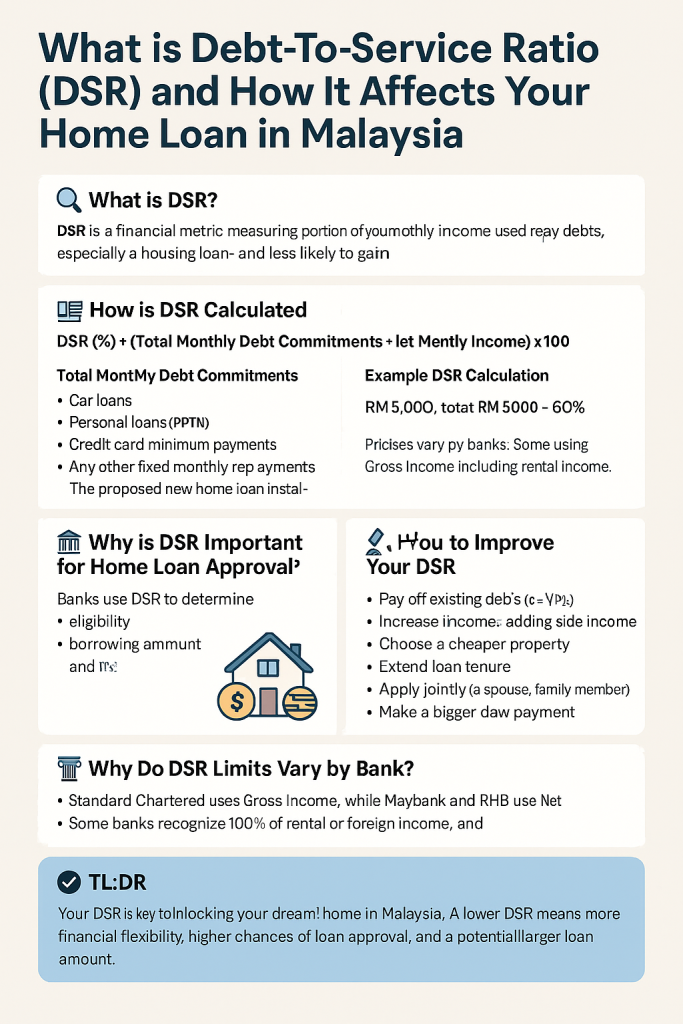
Everything you need to know about DSR
1. What is DSR?
DSR (Debt-To-Service Ratio) is a financial metric that measures the portion of your monthly income used to repay debts. It tells the bank how much of your income is already committed and whether you can afford new loan repayments, especially for a housing loan.
If your DSR is too high, it means you may be financially stretched and less likely to get loan approval.
2. How is DSR Calculated?
The general formula is:
DSR (%) = (Total Monthly Debt Commitments ÷ Net Monthly Income) × 100
Total Monthly Debt Commitments include:
- Car loans
- Personal loans
- Student loans (e.g. PTPTN)
- Credit card minimum payments
- Any other fixed monthly repayments
- The proposed new home loan installment
Net Monthly Income means your salary after deductions such as income tax, EPF, SOCSO, and other mandatory contributions.
📌 Note: Some banks use Gross Income instead, and may include other income like fixed allowances or rental income. Policies vary across banks.
DSR Calculation Example for First-Time Home Buyer
a) Profile
- Name: Aina
- Age: 28
- Employment: Executive at a private company
- Net Monthly Income: RM4,500 (after EPF & tax deductions)
b) Existing Monthly Debt Commitments
| Type of Debt | Monthly Payment |
|---|---|
| Car Loan | RM600 |
| PTPTN Loan | RM150 |
| Credit Card (Min) | RM200 |
| Total Commitments | RM950 |
c) Target Property
- Property Price: RM400,000
- Down Payment: 10% (RM40,000)
- Loan Amount: RM360,000
- Tenure: 35 years
- Estimated Monthly Mortgage (at 4% interest): ~RM1,500
d) New DSR Calculation
Total Commitments (including new mortgage):
RM950 (existing) + RM1,500 (housing loan) = RM2,450
DSR = (RM2,450 ÷ RM4,500) × 100 = 54.4%
Conclusion
She is likely eligible for the loan, provided her credit record (CTOS/CCRIS) is clean and other criteria are met.
Aina’s DSR is 54.4%, which is within the 60–70% range accepted by most banks.
3. Why is DSR Important for Home Loan Approval?
Banks use DSR to determine:
- Whether you’re eligible for a loan
- How much you can borrow
- Whether you’re high risk or low risk
Here’s how DSR affects your mortgage journey:
| DSR Range | Bank’s Likely Response |
|---|---|
| Below 60% | High chance of approval |
| 60% – 70% | Considered with scrutiny |
| Above 70% | High risk of rejection |
If your DSR is above the bank’s threshold, they may:
- Reject your application
- Approve a lower loan amount
- Ask you to apply with a joint applicant
Example DSR Calculation
Let’s say your net monthly income is RM5,000, and your total monthly debt (including your proposed housing loan) is RM3,000.
DSR = (RM3,000 ÷ RM5,000) × 100 = 60%
If the bank’s limit is 70%, you are likely to get approved. But if your total commitment exceeds RM3,500 (70%), you may face rejection unless adjustments are made.
4. Why Do DSR Limits Vary by Bank?
Each bank has its own DSR threshold and income recognition method, for example:
- Standard Chartered uses Gross Income, while Maybank and RHB use Net Income.
- Some banks recognize 100% of rental income or foreign income, others only partially.
- A bank may accept 70% DSR for high-income earners, but only 40% for low-income applicants.
That’s why your loan could be rejected by one bank, but accepted by another.
5. How to Improve Your DSR
Improving your DSR increases your chances of loan approval and may allow you to borrow more. Here’s how:
- Pay Off Existing Debts – Settle small loans or credit card balances.
- Increase Your Income – Consider adding side income or a rental income stream.
- Choose a Cheaper Property – Lower mortgage payments = lower DSR.
- Extend Your Loan Tenure – A longer term reduces monthly installments.
- Apply Jointly – Combine income with a spouse or family member.
- Make a Bigger Down Payment – Borrow less and reduce monthly payments.
6. How the Hire Purchase (Amendment) Act 2026 Could Lower Your Car Loan Burden, and Your DSR
Here’s something many first-time buyers overlook: your car loan is one of the biggest items in your DSR (remember Aina’s RM600 monthly car commitment in the example above). In Malaysia, car loans are a form of hire purchase financing, and the rules governing them changed significantly on 1 June 2026, when the Hire Purchase (Amendment) Act 2026 came into force.
For anyone planning to buy a home, this matters because the new law changes how your car loan interest is calculated and, crucially, how much you’ll still owe if you decide to settle it early to bring your DSR down.
a. What changed?
- Goodbye flat rate and the “Rule of 78.”
Previously, a large share of your early installments went toward interest rather than the principal. That meant settling a car loan early often left you with an outstanding balance much higher than expected. - Reducing Balance Method and Effective Interest Rate
Interest is now calculated on your current outstanding balance, so early settlement is fairer and more transparent; what you owe better reflects the actual cost of the financing. - Digital convenience
Electronic signatures and document submissions are now allowed, speeding up the process. - Stronger fraud protection
Lenders must now run two identity due diligence checks before approving financing.
b. Why this matters for your home loan
If your DSR is sitting just above a bank’s comfort zone, paying down or settling a car loan is one of the fastest ways to lower it. Under the old system, early settlement could be discouragingly expensive.
Under the reformed framework, you’re more likely to see a payoff figure that genuinely reflects what’s left, making “pay off existing debts” (Tip #1 above) a more rewarding move than before.
A few practical notes: 11 financial institutions and hire purchase providers were ready to offer financing under the new rules from day one, while others have a transition window until 31 March 2027 to fully adopt the framework.
A second phase of implementation is expected around September 2026. If you’re taking out a new car loan soon, confirm with your lender which framework applies before you sign.
7. Final Tips Before Applying for a Home Loan
- Always calculate your DSR first to know your borrowing power.
- Check multiple banks—loan approval chances can vary widely.
- Maintain a clean CCRIS/CTOS report. While not part of DSR, it still influences approval.
TL;DR
Your DSR is key to unlocking your dream home in Malaysia. A lower DSR means greater financial flexibility, a higher chance of loan approval, and a potentially larger loan amount. Understanding and managing your DSR before you apply could be the difference between rejection and home ownership.
Let our expert agents at IQI Global help you calculate your DSR and get the best loan options.
Fill in your details below and we’ll match you with a certified property expert who can guide you for free!
Continue reading:
