


Moving out for university is exciting. Signing your first tenancy agreement is less so.
Most students rent with little experience, a tight budget and parents asking questions from home. That is exactly when costly mistakes happen.
This guide walks you through how to rent a house as a student in Malaysia, step by step: what it really costs, where to look, what to check in the agreement and how to spot a scam.
TL;DR
- Budget for the upfront cost, not just rent. Expect to pay about 3.5 to 4 months of rent before you move in.
- Pick the area by commute first. A cheaper room 40 minutes from campus can cost more in time and transport.
- Never pay before a viewing. Deposits requested before you see the unit are the most common scam sign.
- Read the tenancy agreement for duration, early exit, utilities and deposit refund terms.
- Photograph everything on move-in day. It is your best protection for getting your deposit back.
Steps to Rent a House as a University Student
Should you stay on campus or rent outside?
Start here, because it changes everything else. Here is how the two options usually compare.
| Factor | On-campus hostel | Off-campus rental |
|---|---|---|
| Upfront cost | Usually a fixed fee per semester | Deposits plus first month’s rent |
| Utilities | Often included | Often split among housemates |
| Commute | Walking distance | Depends on area and transport |
| Freedom | Curfews and hostel rules may apply | More privacy and flexibility |
| Contract | Semester-based | Usually 12 months |
Hostels suit first-years who want simplicity. Renting outside suits students who want space, cook their own meals or are staying for a few years.
How much does it cost to rent as a student?
The monthly rent is the number everyone looks at. The upfront payment is what catches students out.
In Malaysia, landlords commonly ask for a security deposit of two months’ rent plus a utility deposit, on top of the first month’s rent. Here is a simple worked example, using an illustrative rent of RM800 a month for a room.
| Item | Typical basis | Amount |
|---|---|---|
| Security deposit | 2 months’ rent | RM1,600 |
| Utility deposit | Half to 1 month’s rent | RM400 to RM800 |
| First month’s rent | Paid in advance | RM800 |
| Stamp duty and agreement | Based on rent and tenancy length | Check with landlord or agent |
| Total before move-in | About RM2,800 to RM3,200 + stamp duty |
Figures are an example only. Deposit terms vary by landlord and are agreed in the tenancy agreement.
Then plan your monthly budget. Beyond rent, include your share of electricity, water, internet, transport and food. If you share a unit, agree upfront how bills are split.
| Cost | How to estimate it |
|---|---|
| Electricity | The biggest variable. Air-conditioning drives it. Ask current tenants for their last three bills. |
| Water and sewerage | Usually small. Check whether it is billed per unit or included in rent. |
| Internet | Check if a line is already installed. A new contract may need someone to commit for 12 to 24 months. |
| Maintenance or service charge | Normally paid by the owner. Confirm it is not passed on to you. |
| Transport | Price a monthly public transport pass against e-hailing or parking. Many condos charge for an extra parking bay. |
| Food and household items | Cooking at home cuts costs, but only if the unit has a usable kitchen. |
A simple rule: if rent plus utilities takes more than about a third of your monthly allowance, look for a cheaper room or share with more housemates.
Also check whether the unit is fully furnished or partially furnished. A cheaper partially furnished room can cost more once you buy a bed, mattress, desk and fan.
How to rent a house as a student: 8 steps
1. Set your budget and move-in date

Work out your total upfront cost and monthly limit using the tables above. Start looking 4 to 6 weeks before semester starts, before the best rooms near campus are taken.
Prepare your documents early so you can move fast when you find the right room:
- MyKad, or passport and student pass for international students
- Student ID or university offer letter
- Guarantor details, usually a parent’s IC and contact number, if the landlord asks
- Proof you can pay, such as a scholarship, PTPTN or sponsor letter, or a parent’s commitment
2. Choose your room type
| Option | Best for | Watch out for |
|---|---|---|
| Small or middle room | Lowest budget | Shared bathroom, less space |
| Master room | Privacy with an attached bathroom | Higher rent than other rooms |
| Studio | Full independence | You pay all bills alone |
| Whole unit with friends | Groups who already know each other | One person often signs and carries the risk |
3. Pick an area by commute, not just price

Map the journey to your faculty at class time, not on a Sunday. Check walking distance to a bus stop or LRT/MRT station, food options and whether the area feels safe at night.
Safety matters as much as convenience. Look for guarded buildings with access cards, a well-lit walk from the station, and working fire exits. Female students may prefer female-only units, which are common near campuses.
Popular student areas include Petaling Jaya and Bangsar South for UM, Bandar Sunway and Subang Jaya for Sunway and Taylor’s, Bukit Jalil for APU, Serdang for UPM, Cyberjaya for MMU, Bangi for UKM and Shah Alam for UiTM. For transport, amenities and price trends, see our neighbourhood guides.
4. Search through verified channels
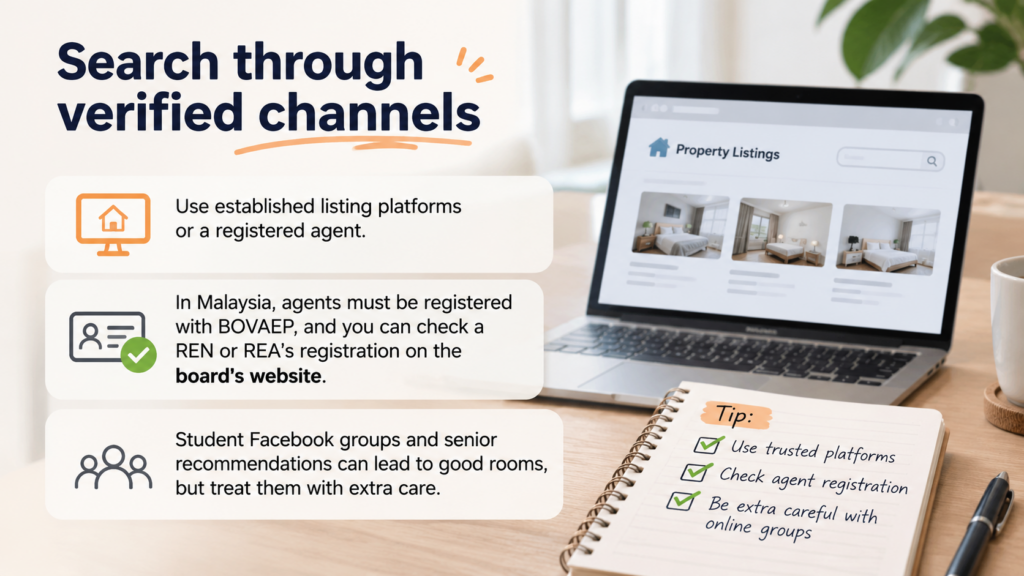
Use established listing platforms or a registered agent. In Malaysia, agents must be registered with the Board of Valuers, Appraisers, Estate Agents and Property Managers (BOVAEP), and you can check a REN or REA’s registration on the board’s website.
Student Facebook groups and senior recommendations can lead to good rooms, but treat them with extra care. Anyone can post there, so the scam checks below matter most for these listings.
5. View the unit in person
If you cannot go, ask a friend or parent, or request a live video call, not pre-recorded clips. During the viewing, check:
- Water pressure, air-conditioning and every light switch
- Signs of leaks, damp or pests
- Phone signal and internet availability
- Locks on the main door and your room door
- Who your housemates are and what the house rules are
- The furniture list, and whether everything on it actually works
Visit at night too if you can. Noise, parking and how safe the walk home feels can be very different after dark.
6. Read the tenancy agreement before you sign

This is where most student disputes start. Check these clauses:
- Duration: most agreements run 12 months. Ask whether a shorter term or a renewal option is possible.
- Early termination: leaving early often means losing your deposit. Know the rule before semester breaks or internships.
- Utilities and maintenance: who pays bills, and who pays for repairs. Many agreements make the tenant pay for minor repairs up to a set amount.
- Deposit refund: when it is returned and what can be deducted.
- Renewal and rent increase: whether you can renew, and how much notice you get of any increase.
- Subletting and guests: most agreements ban subletting. Some limit overnight guests.
- Inventory list: every item supplied should be listed and attached to the agreement.
- Guarantor: some landlords ask a parent to co-sign for students. The guarantor can be liable for unpaid rent or damage.
If a clause is unclear, ask for it to be rewritten before you sign. Verbal promises, like “we will fix the aircon next week”, should be added to the agreement in writing.
For a clause-by-clause breakdown, read our tenancy agreement guide.
7. Pay deposits and stamp the agreement
Pay by bank transfer to the account named in the agreement, never in cash, and keep every receipt.
Tenancy agreements must be stamped with the Inland Revenue Board (LHDN) within 30 days of signing for them to be accepted as evidence if there is a dispute. Stamp duty is based on the annual rent and the length of the tenancy, and is usually paid by the tenant. Check the latest rates on LHDN’s STAMPS portal.
8. Document everything on move-in day
Take dated photos and videos of every room, note existing damage and record the electricity and water meter readings. Share them with the landlord in writing, by email or WhatsApp, so there is a timestamp.
When you move out, this record is what protects your deposit from unfair deductions. Also confirm in writing whose name the utility accounts are in and when bills are due.
Living with housemates and getting your deposit back
Most student rental problems are not with the landlord. They are with housemates, and they usually start over money.
Agree a few house rules in your first week and put them in a group chat so everyone can refer back:
- How bills are split, especially if one room has air-conditioning and others do not
- Who pays which bill and by what date
- A cleaning rota for shared spaces
- Quiet hours during exam weeks, and rules on overnight guests
When it is time to leave, follow these steps to get your deposit back in full:
- Give written notice as required by the agreement
- Clean the unit and repair any damage you caused
- Settle final utility bills and record the closing meter readings
- Do a joint inspection with the landlord, using your move-in photos
- Return all keys and access cards, and get an acknowledgement in writing
If the deposit is not returned on time, follow up in writing and refer to the agreement. As a last resort, small deposit disputes can be filed under the small claims procedure at the Magistrates’ Court, without a lawyer.
| A note for parents If you sign as guarantor, read the agreement yourself, because you may be liable for unpaid rent or damage. Ask for a copy of the stamped agreement, save the landlord’s or agent’s contact details, and visit the unit or join a video viewing before money changes hands. |
How do you spot a rental scam?

Students are frequent targets because they search fast, often from another state or country. Walk away if you see any of these:
- Payment before viewing. “Many people want it, pay a booking fee now” is the classic line.
- Rent far below similar units nearby. If it looks too good to be true, it usually is.
- No viewing allowed, or only photos copied from other listings.
- Payment to a personal account whose name does not match the owner or a registered agency.
- No written agreement, or pressure to sign immediately.
If you are unsure, ask to see proof of ownership or the agent’s registration, and check it yourself.
Landlords commonly ask for a security deposit of two months’ rent plus a utility deposit of around half to one month’s rent, on top of the first month’s rent. Terms vary and are set in the tenancy agreement.
The tenant usually pays, unless the agreement says otherwise. The agreement should be stamped with LHDN within 30 days of signing, and the duty is based on the annual rent and the tenancy length.
Yes. Landlords usually ask for a passport and a valid student pass, and some request a guarantor or a larger deposit. Check that the tenancy length fits within your visa period.
A single room is usually cheapest for one person. Renting a whole unit with friends can work out cheaper per head, but one person often signs the agreement and carries the risk if others leave.
Never pay before viewing the unit in person or by live video, pay only to an account named in a written agreement, and check the agent’s registration with BOVAEP. Be wary of rent far below similar units nearby.
Give written notice as the agreement requires, clean and repair any damage you caused, settle final bills, do a joint inspection using your move-in photos and return all keys with a written acknowledgement. The refund timeline should be stated in the agreement.
R
Looking for a room near campus?
Browse verified rental listings around Malaysia’s university towns, or ask a registered IQI agent to shortlist units for you.
Continue Reading:
