


| TL;DR The NAPIC Q1 2026 data shows that Malaysia recorded 89,966 property transactions worth RM51.09 billion, while transaction volume fell 8% year-on-year and value slipped 0.6%. House prices still increased by 1.7%, but completed unsold residential units rose to 32,801. Meanwhile, the average subsale home price increased 4.8% to RM545,059, showing that established properties continued to attract demand despite a slower overall market. |
Malaysia’s property market entered 2026 with the sort of mixed signals that make buyers reach for coffee and a calculator.
The NAPIC Q1 2026 data shows fewer transactions, slightly higher house prices, and more completed homes sitting unsold. That does not mean the market is crashing or booming. It means buyers must read beyond the headline and use the numbers to judge price, supply, financing, and negotiation power.
Key Takeaway
- Malaysia recorded 89,966 property transactions worth RM51.09 billion in Q1 2026, with transaction volume falling 8% year-on-year.
- The Malaysian House Price Index reached 235.2 points, up 1.7% year-on-year, with the national average house price at RM507,533.
- Completed unsold residential stock reached 32,801 units, while the serviced apartment overhang increased to 19,263 units.
- The average subsale home price rose 4.8% to RM545,059, while Kuala Lumpur’s average crossed RM1 million.
- Around seven in ten subsale transactions involved homes priced at RM500,000 or below, showing that entry-level and middle-market buyers remained the main source of demand.
What You Should Know About NAPIC Q1 2026 Report
- 1. What Does the NAPIC Q1 2026 Report Say About Malaysia’s Property Market?
- 2. Why Did Malaysian House Prices Rise While Property Transactions Fell?
- 3. How Serious Is Malaysia’s Property Overhang in Q1 2026?
- 4. How Is Malaysia’s Subsale Property Market Performing in 2026?
- 5. Is It Better to Buy a Subsale Property or a New Launch in Malaysia in 2026?
- 6. How Can Buyers Use NAPIC Data Before Purchasing a Property?
- 7. What Should Malaysian Property Buyers Watch for During the Rest of 2026?
- 8. Frequently Asked Questions (FAQs)
Estimated reading time: 17 minutes
1. What Does the NAPIC Q1 2026 Report Say About Malaysia’s Property Market?
Malaysia’s market remained stable in value but slower in activity. The total value of completed transactions barely changed from a year earlier, but fewer properties changed hands. At the same time, modest price growth and higher unsold stock created a more selective market for buyers, sellers and developers.
a. How Many Property Transactions Were Recorded in Q1 2026?
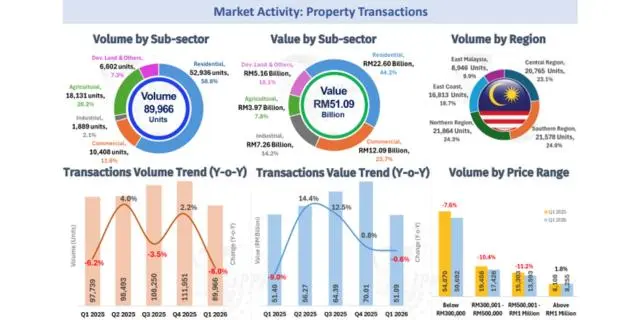
The National Property Information Center, under JPPH Malaysia, recorded 89,966 transactions worth RM51.09 billion during Q1 2026. Transaction volume fell 8% from Q1 2025, while total value declined only 0.6%.
The difference between those two figures matters. A large fall in property transaction volume, combined with a small decline in value, means the average value per completed deal remained relatively firm. The market did not suffer a broad price collapse. Instead, fewer buyers and sellers successfully completed transactions.
The residential property market remained the largest segment, accounting for 58.8% of all transactions. It recorded 52,936 deals worth RM22.60 billion during the quarter. Commercial property represented 11.6% of volume, followed by agricultural property at 20.2%, development land and other property at 7.3%, and industrial property at 2.1%.
b. Which Price Bands Recorded the Most Activity?
Homes priced at RM300,000 and below recorded 27,209 residential transactions, making this the most active residential price band. This shows that demand for affordable housing remained strong even as the overall market slowed.
However, high activity does not mean every affordable project sells easily. Financing eligibility, location, unit design, and access to daily amenities still determine whether demand turns into an actual purchase. The Malaysian Reserve noted that the below-RM300,000 segment had strong activity but also carried substantial unsold stock.
c. Malaysia Property Market Q1 2025 vs Q1 2026
| Metric | Q1 2025 | Q1 2026 | Market signal |
|---|---|---|---|
| Total property transactions | 97,739 | 89,966 | Activity slowed |
| Total transaction value | RM51.40 billion | RM51.09 billion | Value remained relatively stable |
| Residential completions | 9,329 units | 12,905 units | More completed supplies entered the market |
| Residential construction starts | 28,344 units | 8,243 units | Developers became more cautious |
| New residential launches | 12,498 units | 9,112 units | Launch volume declined |
| New-launch sales rate | 10.8% | 11.5% | Take-up improved slightly, but remained low |
The table shows a market with more completed homes but fewer new starts. Developers delivered projects already under construction while reducing immediate construction activity. This suggests greater caution over demand, financing, and future project costs.
2. Why Did Malaysian House Prices Rise While Property Transactions Fell?
House prices rose because price movement and sales activity measure different things. The house price index tracks the prices of homes sold through completed transactions. It does not measure how quickly every listed property sold or how many sellers failed to find buyers.
a. What Was the Malaysian House Price Index in Q1 2026?
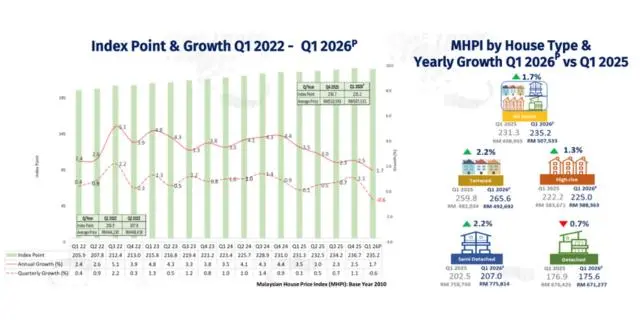
The Malaysian House Price Index, or MHPI, reached 235.2 points in Q1 2026. This represented 1.7% year-on-year growth and placed the national average house price at RM507,533.
A 1.7% increase means average house prices remained firm, but it was not rapid growth. Sellers could still face longer waiting periods, especially when their asking price exceeded the prices of recent transactions in the same neighborhood.
This is why buyers should separate price direction from market liquidity. A neighborhood may record stable prices while only a small number of homes sell. In that situation, a realistic seller may complete a deal, while an optimistic seller may keep waiting.
b. Which Property Types Recorded the Strongest Growth?
Terraced and semi-detached homes recorded the strongest year-on-year house price growth, with both increasing by 2.2%. High-rise property prices rose 1.3%, while detached house prices fell 0.7%.
The results show that landed property prices generally outperformed high-rise and detached homes during the quarter. This does not mean every landed house is a good purchase. It means demand remained stronger for certain mainstream landed formats, especially where buyers could access established communities and infrastructure.
c. What Does a Thinner Market Mean for Buyers?
A market with fewer completed deals gives prepared buyers more negotiation power, particularly when a seller has been marketing a property for a long time. The strongest offer is not always the lowest offer. It is often the offer supported by approved financing, a realistic completion timeline, and clear transaction evidence.
Consider two similar condominium units in the same development. One seller prices according to a recent completed transaction, while the other follows higher online asking prices. A buyer who compares actual transactions can identify which unit offers better market value without assuming every advertised discount is a bargain.
3. How Serious Is Malaysia’s Property Overhang in Q1 2026?
Malaysia’s residential overhang became significantly larger in Q1 2026. Completed unsold residential units reached 32,801, while completed unsold serviced apartments reached 19,263. These figures create opportunities for negotiation, but they also warn buyers to examine resale demand carefully.
a. How Many Completed Residential Units Were Unsold?
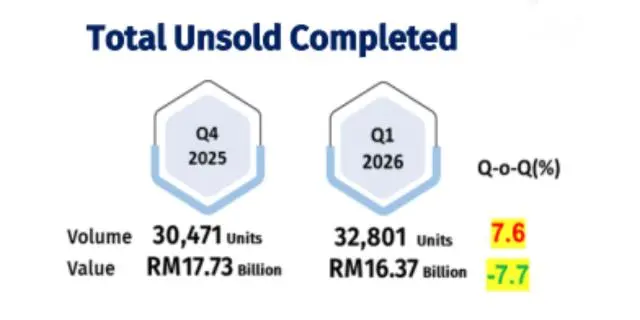
Malaysia had 32,801 completed, unsold residential units valued at RM16.37 billion in Q1 2026. The number of units increased 7.6% from the preceding quarter, although their total value fell 7.7%.
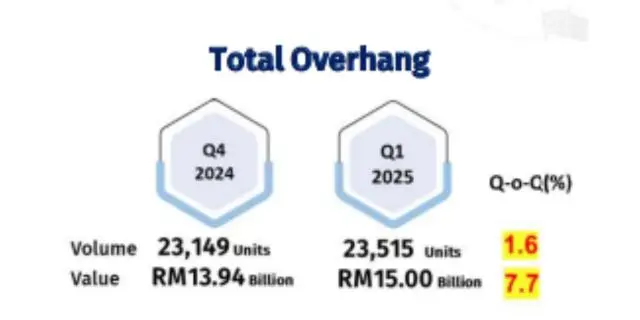
For comparison, in Q1 2025, the residential overhang stood at 23,515 units, valued at RM15 billion. The rise between the two snapshots shows that the completed supply accumulated faster than buyers absorbed it.
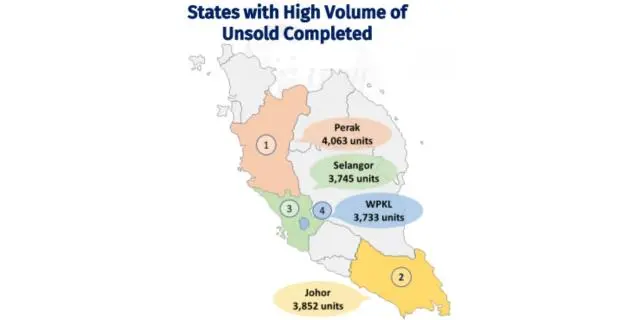
The largest number of completed unsold residential units was recorded in Perak, at 4,063. Johor followed with 3,852 units, Selangor with 3,745 units, and Kuala Lumpur with 3,733 units.
These state totals should not be used to label an entire market as weak. Property overhang is usually concentrated in particular projects, price bands, and property types. A well-connected home with realistic pricing can perform differently from an oversupplied project elsewhere in the same state.
b. Why Is the Serviced Apartment Overhang Important?
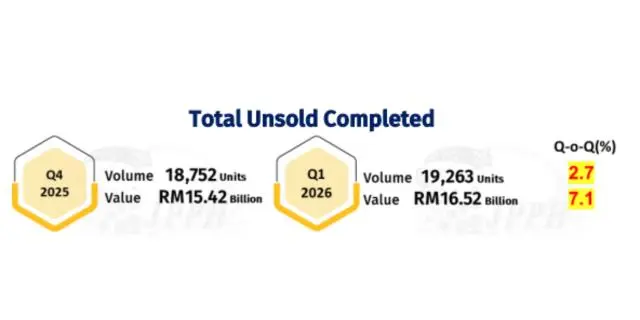
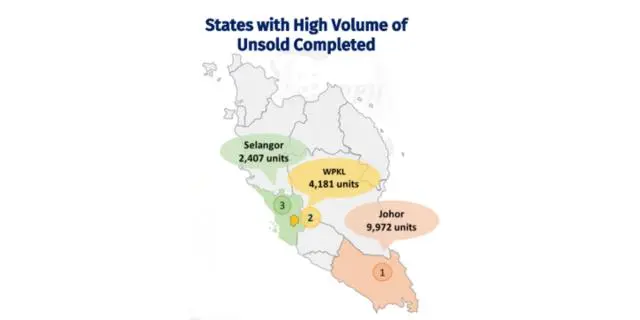
Completed unsold serviced apartments totaled 19,263 units, valued at RM16.52 billion. Johor accounted for 9,972 units, Kuala Lumpur for 4,181 units, and Selangor for 2,407 units.
A large portion of this supply fell within the RM500,001 to RM1 million price band, accounting for 58.5% of completed unsold serviced apartments. Buyers comparing these units should examine monthly maintenance charges, occupancy, nearby supply, and past resale activity rather than focusing solely on promotional packages.
| Unsold category | Q1 2026 units | Q1 2026 value | What buyers should examine |
|---|---|---|---|
| Completed residential homes | 32,801 | RM16.37 billion | Project-level demand, condition, and competing supply |
| Completed serviced apartments | 19,263 | RM16.52 billion | Holding costs, resale liquidity, and nearby competition |
A high overhang can improve buyer negotiation power, especially when developers or owners want to reduce holding costs. It can also indicate that future resale may take longer. The correct response is not to avoid every overhang area. This investigation aims to determine why each unit remains unsold.
4. How Is Malaysia’s Subsale Property Market Performing in 2026?
Malaysia’s subsale property market started 2026 more strongly than the broader house price index. The national average subsale home price increased 4.8% year-on-year to RM545,059, compared with the MHPI’s 1.7% increase.
The subsale findings came from the IQI residential subsale report that analyzed more than 230,000 transactions recorded since 2018. Our report shows that buyers continued to pay for established locations, infrastructure, and connectivity even as overall national transaction activity slowed.
a. Which Major Subsale Markets Recorded the Strongest Performance?
Kuala Lumpur recorded the strongest growth among the major markets covered. Its average subsale house price reached RM1,024,793, a 15% year-on-year increase. Melaka’s average increased 10% to RM358,964.
Selangor, Malaysia’s largest subsale market by transaction volume, remained broadly stable at an average price of RM559,935. Penang’s average declined 2%, while Negeri Sembilan declined 5% to RM340,207, making it the most affordable of the five markets tracked in our report.
These results do not create a universal list of the best states for subsale property. Kuala Lumpur showed strong price growth, while Negeri Sembilan offered a lower average entry price. The better market depends on whether the buyer wants a home, rental income, future resale flexibility, or a lower purchase price.
b. Which Price Segments Dominated Subsale Transactions?
Nearly one-quarter of subsale purchases involved homes priced at RM250,000 or below, while roughly seven in ten involved properties below RM500,000. Homes above RM1 million accounted for 8% of transactions, and homes between RM750,000 and RM1 million accounted for 6%.
As IQI Group CEO Kashif Ansari stated, “Affordable homes remain the engine of transaction volume.” The figures show that premium urban markets may attract attention, but affordable and middle-market buyers continue to generate most secondary-market activity.
| Indicator | Overall housing market | Subsale market |
|---|---|---|
| Q1 2026 price growth | MHPI up 1.7% | Average subsale price up 4.8% |
| Average price | RM507,533 | RM545,059 |
| Strongest demand signal | Homes at RM300,000 and below | Around 70% of transactions are below RM500,000 |
| Main buyer consideration | Supply, financing, and local overhang | Comparable transactions, conditions, and established demand |
The comparison shows why buyers should not treat the secondary property market as a smaller copy of the new-home market. Subsale homes have existing transaction records, physical conditions, and neighborhood demand that buyers can examine before making an offer.
5. Is It Better to Buy a Subsale Property or a New Launch in Malaysia in 2026?
A subsale property is generally more suitable for buyers who value an established location, a completed unit, and visible transaction history. A new launch may be more suitable for buyers who prefer developer packages, newer facilities, and a longer period before completion.
a. What Are the Main Advantages of Buying a Subsale Home?
With a subsale home, buyers can inspect the actual property condition, review the surrounding neighborhood, and compare recent transactions before committing. This can reduce uncertainty about the finished product, although older homes may require repairs or renovation.
Subsale buyers can also study existing resale demand. They can examine how frequently similar units change hands and whether the location attracts owner-occupiers, tenants, or both. This is especially important in a market where transaction volume has fallen.
The seller’s situation can create room to negotiate. A financing-ready buyer may have an advantage when a property has been listed for a long period. However, the buyer should base the offer on local comparable transactions rather than a general national discount assumption.
b. What Does the New-Launch Data Show?
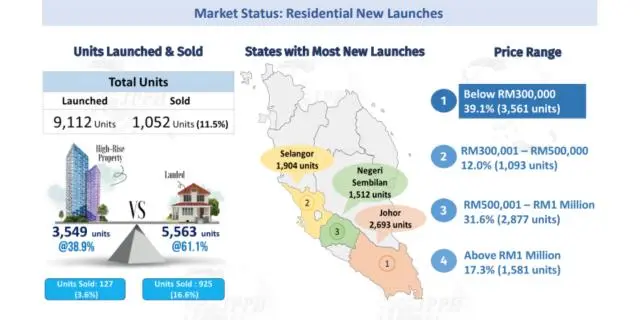
Developers launched 9,112 residential units in Q1 2026 and sold 1,052 units, giving a sales rate of 11.5%. Landed homes represented 61.1% of launched units, while high-rise homes represented 38.9%.
Johor recorded the highest number of new residential launches, with 2,693 units. Selangor followed with 1,904 units and Negeri Sembilan with 1,512 units. The total launch volume was lower than the 12,498 units recorded in Q1 2025.
c. Subsale vs New Launch: What Should Buyers Compare?
| Decision factor | Subsale property | New launch |
|---|---|---|
| Property inspection | The actual completed unit can be checked | Buyer relies on plans, show units, and developer delivery |
| Neighbourhood | The existing environment can be assessed | The surrounding area may still be developing |
| Price evidence | Recently completed transactions may be available | Price is mainly based on the developer’s launch structure |
| Physical condition | Repairs or renovation may be needed | Unit is new when delivered |
| Completion | Usually available after the transaction process | The buyer may wait for the construction |
| Negotiation basis | Seller urgency and comparable sales | Developer packages and remaining inventory |
| Resale assessment | Existing demand can be reviewed | Future resale demand is less certain |
The subsale vs new launch decision should start with the buyer’s budget, financing position, preferred location, move-in timeline, and intended holding period. There is no single winner for every buyer.
IQI Global can help buyers compare subsale and new-launch options based on location, budget, and intended use. The final decision should still be supported by confirmation of financing, legal advice, and property-level due diligence. Contact us now!
6. How Can Buyers Use NAPIC Data Before Purchasing a Property?
Buyers should use NAPIC property data to understand the wider market, then narrow their research to the state, neighborhood, project, and property type they are considering.
- Check Transaction Volume, Not Only Price Growth
The MHPI shows the direction of completed house prices, while transaction volume shows how active the market is. When prices rise, but transaction volume falls, buyers should expect more variation between properties that sell and those that remain listed.
- Compare the Property With the Active Price Bands
NAPIC recorded the strongest overall residential activity at RM300,000 and below, while the IQI subsale report found that roughly seven in ten secondary-market transactions were below RM500,000. These figures help buyers understand broad demand, but they do not replace local comparisons.
- Review Overhang by Property Type and Location
A buyer should ask whether a high property overhang comes from poor location, unsuitable layouts, high pricing, or too many similar units. High supply may improve negotiation opportunities, but it can also create competition when the owner wants to resell.
- Confirm Financing Before Viewing Seriously
The housing loan approval rate fell to 39.2% during the first four months of 2026, compared with 41% in 2025 and 42% in 2024. This financing gap helps explain why buyer interest does not always become a completed transaction.
A confirmed borrowing range gives buyers more control. It prevents them from spending weekends visiting homes that their bank will not finance. More importantly, property loan approval can make an offer more credible when negotiating with a motivated seller. - Negotiate With Evidence
Useful evidence includes recently completed transactions, the unit’s condition, nearby competing listings, project overhang, and the seller’s expected timeline. A buyer should use these facts to support a realistic property offer, rather than choosing a random discount and hoping it works.
- Check Available First-Time Buyer Support
The full stamp duty exemption for Malaysian first-time buyers purchasing homes priced up to RM500,000 was extended through 31 December 2027. The Housing Credit Guarantee Scheme allocation was also increased to RM20 billion, with the measure expected to benefit 80,000 buyers.
These measures may reduce barriers for eligible buyers, but first-time home buyer incentives do not make an unsuitable property affordable. Monthly repayments, maintenance costs, location, and long-term needs still matter.
7. What Should Malaysian Property Buyers Watch for During the Rest of 2026?
The most important signals are loan approvals, unsold stock, launch activity, and construction costs. These indicators show whether demand is converting into transactions and whether developers are becoming more confident.
The residential overhang in Q1 2026 was about 49% higher than in Q3 2024, according to The Malaysian Reserve. If financing remains difficult, completed unsold stock may take longer to clear.
At the same time, residential construction starts fell from 28,344 units in Q1 2025 to 8,243 units in Q1 2026. Planned residential supply increased to 12,852 units, showing that developers had future projects in the pipeline but were cautious about beginning construction immediately.
CIMB Securities senior analyst Kenny Mak Hoy Ken said tender costs for upcoming projects could increase by 5% to 15%, while launches could face delays as developers move projects into the second half of 2026.
Affordable and mid-market homes, landed properties, integrated townships, selected Johor developments, and industrial assets were identified as relatively resilient property segments. These are market themes, not guaranteed winners. Buyers must still check individual pricing, financing, and demand.

The NAPIC property market report Q1 2026 does not describe a boom or a crash. It describes a selective market. Prices held up, transactions slowed, and unsold stock grew, while the secondary property market recorded stronger price growth in several established areas.
Buyers should focus on financing, local transaction evidence, property condition, and exit demand. In 2026, preparation is more valuable than guessing the next headline.
8. Frequently Asked Questions (FAQs)
The Malaysian property market Q1 2026 remained stable in value but slower in volume. Malaysia recorded 89,966 property transactions worth RM51.09 billion. Transaction volume fell by 8%, transaction value declined by 0.6%, and the Malaysian House Price Index increased by 1.7%.
The average house price in Malaysia was RM507,533 in Q1 2026. The Malaysian House Price Index stood at 235.2 points, representing year-on-year growth of 1.7%. This was modest growth rather than a rapid nationwide price increase.
House prices and transaction volume measure different parts of the market. The price index tracks homes that completed transactions, while transaction volume counts how many deals closed. Prices can therefore rise when better-positioned homes sell, even if weaker or overpriced properties remain unsold.
Malaysia recorded 32,801 completed unsold residential units worth RM16.37 billion in Q1 2026. The number of units increased 7.6% from the preceding quarter, while their total value declined 7.7%.
Yes. The average subsale property price increased 4.8% year-on-year to RM545,059 in Q1 2026. Kuala Lumpur recorded particularly strong growth, with its average subsale price rising 15% to more than RM1.02 million.
It can be a suitable time for a financing-ready subsale buyer who finds a well-priced home with established demand. Transaction volume is lower, which may improve negotiation opportunities. Buyers should still compare recent transactions, inspect the property, and confirm financing before committing.
A subsale property offers a completed unit, an established neighborhood, and clearer transaction evidence. A new launch may offer newer facilities and developer packages. The better choice depends on budget, financing, move-in timing, property condition, and the buyer’s intended holding period.
Explore suitable subsale and new-launch properties with IQI Global, or speak with a local property professional before making your next move.
Continue Reading
- Financial Terms Every Home Buyer in Malaysia Should Know Before Buying a House
- Top 10 Cheapest Neighborhoods in Klang Valley (2026)
- MM2H Explained: Why Malaysia Is a Safe Haven for Property Investors in 2026
Reference
- Annuar, A. (2026, June 29). Property market to consolidate in 2026 as financing gap persists. The Malaysian Reserve. Retrieved from
https://themalaysianreserve.com/2026/06/29/property-market-to-consolidate-in-2026-as-financing-gap-persists/ - Business Today. (2026, June 22). Residential sub-sale grew 4.8% in Q1 2026, KL now RM1 million housing market. Retrieved from
https://www.businesstoday.com.my/2026/06/22/residential-sub-sale-grew-4-8-in-q1-2026-kl-now-rm1-million-housing-market/ - Yaacob, H. (2026, May 15). Malaysia’s property market stays stable in 1Q2026 with transactions near 90,000 units worth RM51.9b, says JPPH. EdgeProp. Retrieved from https://www.edgeprop.my/content/1916127/malaysias-property-market-stays-stable-1q2026-transactions-near-90000-units-worth-rm519b-says-jpph
- Malay Mail. (2026, June 22). Malaysia’s subsale home prices climb 4.8pc to RM545,059, Kuala Lumpur breaks RM1m mark. Retrieved from
https://www.malaymail.com/news/malaysia/2026/06/22/malaysias-subsale-home-prices-climb-48pc-to-rm545059-kuala-lumpur-breaks-rm1m-mark/224728 - National Property Information Centre. (2026). Property market Q1 2026 snapshots. Retrieved from https://napic.jpph.gov.my/storage/app/media/3-penerbitan/Shahrul/SnapShot/Q1%202026/Snapshot%20Q1%202026%20EN.pdf
- National Property Information Centre. (n.d.). Property market Q1 2025 snapshots. Retrieved from https://napic.jpph.gov.my/storage/app/media//3-penerbitan/Shahrul/SnapShot/Q1%202025/1.%20Property%20Market%20Q1%202025%20Snapshots.pdf
- Sharen Kaur. (2026, June 26). Malaysia’s property sector faces rising costs, delayed launches amid softer demand [WATCH]. New Straits Times. Retrieved from https://www.nst.com.my/property/2026/06/1473180/malaysias-property-sector-faces-rising-costs-delayed-launches-amid-softer
- Yaacob, H. (2026, May 15). Malaysia’s property market stays stable in 1Q2026 with transactions near 90,000 units worth RM51.9b, says JPPH. EdgeProp. Retrieved from https://www.edgeprop.my/content/1916127/malaysias-property-market-stays-stable-1q2026-transactions-near-90000-units-worth-rm519b-says-jpph
