


The contents of this article were contributed by K. Soma Sundram, Registered Estate Agent with 36 years of experience.
Thinking about becoming a property agent in Malaysia? Here is the part nobody tells you upfront: you can be legally registered and holding your tag in about four to eight weeks, and the whole thing costs less than a decent phone.
The hard part is not the paperwork. It is what you do in the 90 days after the tag arrives.
Property agents in Malaysia are formally called Real Estate Negotiators, or RENs. You are the bridge between buyers, sellers, landlords and tenants. You market properties, arrange viewings, negotiate the deal and shepherd the paperwork until keys change hands.
This guide walks the full path: eligibility, the NCC course, the BOVAEP registration, the real costs, how commission actually pays out, and what the job is like once the excitement wears off.
TL;DR: BECOMING A PROPERTY AGENT IN MALAYSIA
- Entry role: Real Estate Negotiator (REN), not “agent”. A Registered Estate Agent (REA) is a separate, five to six year qualification.
- Minimum requirements: 18 years old, SPM or equivalent (with a pass in Bahasa Malaysia for applications from 1 October 2024), and a non-bankruptcy certificate.
- Training: the two-day Negotiator Certification Course (NCC), roughly RM600 plus service tax, ending in a short assessment.
- You cannot go solo. Every REN must be attached to a BOVAEP-registered agency, which submits your REN tag application for you.
- Timeline: typically four to eight weeks from booking the NCC to holding your tag.
- Pay: commission only, no basic salary. The regulated ceiling on a sale is 3% of the price, and one month’s rent on a tenancy of up to three years.
- Renewal: annual. Miss it and you retake the NCC from scratch.
- Practising without a tag risks a fine of up to RM300,000, up to three years’ jail, and you cannot sue anyone for your commission.
What Does a Property Agent Do?
The terms “Real Estate Agent” or “Property Agent” are commonly used to refer to real estate salespeople.
Showing houses is maybe a fifth of the job. The rest is closer to marketing, research and project management.
- Winning and marketing listings. Photographing units, writing copy, pushing them onto portals, social media and your own network.
- Qualifying enquiries. Separating serious buyers from window shoppers before you burn a Saturday on viewings.
- Running viewings. Coordinating access, owners, tenants and security, often at nights and weekends.
- Pricing and market research. Knowing what the block next door actually transacted at, not what the owner hopes it is worth.
- Negotiating. Handling offers, counteroffers and the emotional bits in between.
- Shepherding the paperwork. Booking forms, SPAs, loan applications, lawyers, developers and bankers, until the deal completes.
The deal is not done when the offer is accepted. It is done when the loan is released, and chasing that gap is where good agents earn their keep.
REN, PEA or REA: which one are you becoming?
Malaysians use “property agent” loosely, but the law does not. There are three distinct registrations, and knowing which one you are applying for saves a lot of confusion.
| REN Real Estate Negotiator | PEA Probationary Estate Agent | REA Registered Estate Agent | |
|---|---|---|---|
| Training required | Two-day NCC | BOVAEP Part I and Part II examinations | Exams, two years of supervised practice, then the Test of Professional Competence (TPC) |
| Time to qualify | Four to eight weeks | Two to four years of study | Around five to six years in total |
| Can work independently? | No. Must be attached to a registered firm | No. Practising under an REA’s supervision | Yes |
| Can own a firm or hire negotiators? | No | No | Yes. Only an REA may run an agency |
| Best for | Anyone starting out, career switchers, part-timers testing the water | RENs who want to go professional | Agents building their own agency and income from a team |
Almost everyone starts as a REN. It is the fastest legal route into the industry, and nothing stops you working towards the REA qualification later while you earn.
Want the long-form version covering the full REN to REA journey? Read our complete guide to becoming a real estate agent in Malaysia.
Who can register as a REN in Malaysia?
The bar is lower than most people assume. You need:
- Age 18 or above. That is the legal minimum.
- SPM or equivalent. A pass in Bahasa Malaysia has been required for applications from 1 October 2024. Many agencies also prefer at least three credits, and subjects like Mathematics, Economics or Accounts help, though they are not a legal barrier.
- A non-bankruptcy certificate from the Insolvency Department (Jabatan Insolvensi Malaysia). This one surprises people, so apply early.
- Malaysian citizenship or permanent residency, or a valid work permit for non-residents.
- Identity documents: IC or passport, plus a passport-sized photo.
No degree. No prior sales experience. No property background required at all. Some of the strongest agents in the market came from teaching, engineering, banking, F&B and aviation.
How to be a property agent in Malaysia in 5 steps
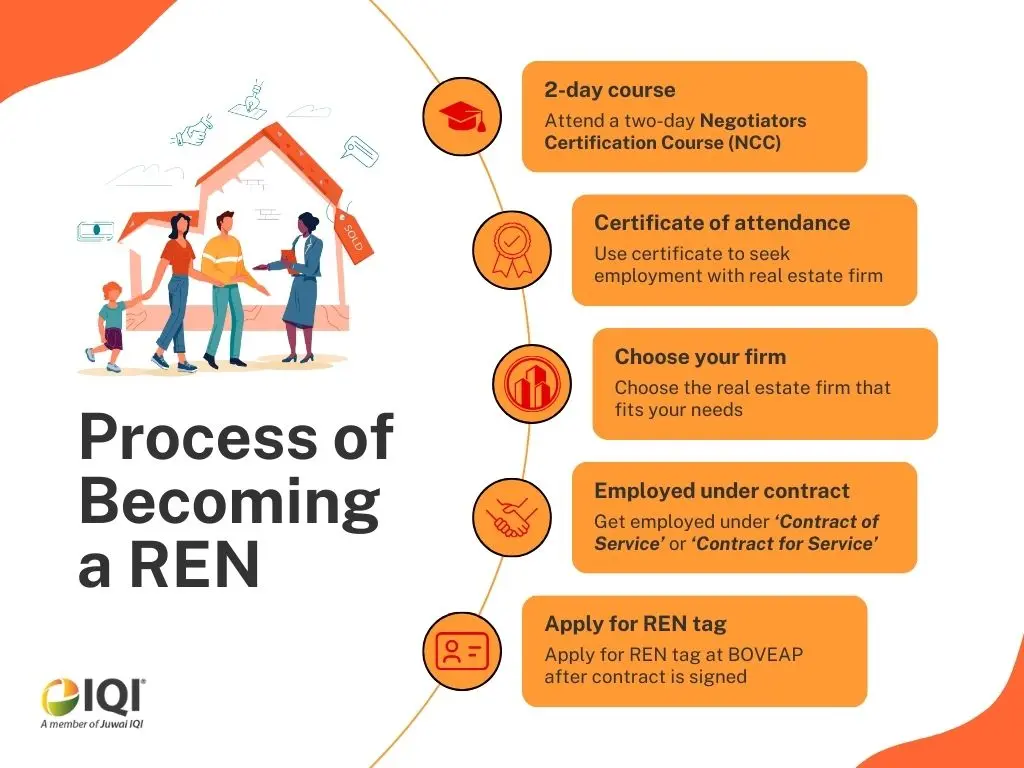
This is the whole path. Everything else in this article supports these five steps.
Step 1: Pass the Negotiator Certification Course (NCC)
The NCC is a two-day course run by training providers accredited by the Board of Valuers, Appraisers, Estate Agents and Property Managers (BOVAEP, also known as LPEPH).
It covers the law you are about to work under, professional ethics, agency practice and the basics of a transaction. On day two you sit a short online assessment, typically around 20 questions. Pass it and you receive your NCC certificate.
Attendance on both days is compulsory. Turn up late for one and you will be rebooking the whole course.
Step 2: Join a BOVAEP-registered real estate agency
You cannot register as a REN on your own, and you cannot practise as a freelancer. The law requires you to be attached to a registered firm, and that firm is the one that submits your application.
This is the single decision that most affects your first year of income, so do not pick the first agency that replies to your Instagram DM. There is a full section on choosing well further down.
Step 3: Submit your REN tag application through the agency
Your agency lodges the application with BOVAEP on your behalf. Prepare:
- NCC certificate
- Copy of your IC or passport
- Passport-sized photograph
- Letter of employment or appointment from the agency
- Non-bankruptcy certificate
Incomplete documents are the number one cause of delay. Get the non-bankruptcy certificate moving before you even sit the NCC.
Step 4: Receive your REN tag and start practising
Once approved, BOVAEP issues a REN tag carrying your name, photo, IC number, a unique REN number, your firm’s details and a QR code that anyone can scan to verify you.
You are required to wear it when conducting business. That tag is also your client’s proof that you are real, which matters more than new agents realise in a market with plenty of illegal brokers.
Step 5: Renew every single year
REN registration is renewed annually through your agency, and renewal is tied to continuing professional development. This is the step people forget.
Let your registration lapse and you do not simply pay a late fee. You retake the NCC and reapply from the beginning.
Thinking about becoming a property agent? Great choice!
Property agents, also called Real Estate Negotiators (RENs) in Malaysia, act as the bridge between buyers, sellers, landlords, and tenants.
Your job is to market properties, arrange viewings, negotiate deals, and handle all the paperwork to ensure smooth transactions for your clients.
Before you begin your career journey, let’s learn what it takes to succeed in the real estate industry!
Guide to Starting a Real Estate Career in Malaysia
- What Does a Property Agent Do?
- How to be a property agent in Malaysia in 5 steps
- How long does it take, and what does it cost?
- What skills do you need to be a estate agent?
- Understanding Malaysia’s Real Estate Market
- Key Takeaways
- Choosing the Right Real Estate Agency: Why IQI is Your Best Choice
- Frequently Asked Questions
How long does it take, and what does it cost?
Two questions, one honest answer: faster and cheaper than almost any other licensed profession in Malaysia.
| Stage | Typical time | Typical cost |
|---|---|---|
| Non-bankruptcy certificate | A few days to two weeks | Nominal government fee |
| NCC course and assessment | 2 days, plus waiting for the next intake | From around RM600 plus service tax, varying by provider |
| BOVAEP REN tag processing | Two to six weeks | Board fee, often handled by the agency |
| Getting deal-ready (photos, listings, name cards, portal credits) | Ongoing from day one | Budget a few hundred ringgit a month at the start |
| Total to legally start | Roughly 4 to 8 weeks | Under RM1,000 in most cases |
Fees are set by course providers and the Board and change from time to time. Confirm the current figures with your training provider and agency before committing.
The real cost is not money, it is runway. Commission takes time to land, so plan for three to six months of living expenses before you give up other income.

The real cost is not money, it is runway. Commission takes time to land, so plan for three to six months of living expenses before you give up other income.
What skills do you need to be a estate agent?
To succeed in this field, you’ll need: Listening more than pitching. Most new agents talk too much. The ones who close ask what the family actually needs, then match it.
Negotiation without desperation. Handling offers, counteroffers and awkward silences on behalf of both sides.
Local market knowledge. Transacted prices, rental yields, upcoming MRT and highway links, school catchments, which blocks have management issues.
Digital marketing. Property discovery starts online. You need decent listing photos, video walkthroughs, portal copy that ranks and a personal brand people remember.
Networking that compounds. Bankers, lawyers, renovators, developers and other agents send more business than cold leads ever will.
Time and pipeline discipline. Juggling ten clients at different stages is the actual job. A CRM beats a notebook by month three.
Integrity under pressure. This is the biggest financial decision most clients will make. One dishonest deal ends a career that took years to build.The honest pros and cons of being a property agent
Anyone who tells you this career is easy money is recruiting you, not advising you.
| The upside | The reality check |
|---|---|
| No salary ceiling. Commission scales with performance, and nothing caps your upside | No salary floor either. A quiet month pays nothing |
| You control your schedule | Clients control your weekends and evenings |
| Very low cost to enter for a licensed profession | Low barrier means crowded competition, so you must differentiate |
| Skills transfer everywhere: sales, negotiation, finance, marketing | Deals collapse late, often at the loan stage, after weeks of work |
| You can build a team and earn from a structure, not just your own hours | You are self-employed. EPF, SOCSO and tax are yours to manage |
| Genuinely varied work and a wide network | First deal commonly takes two to four months. Patience is a requirement |
Treat the first six months as an apprenticeship you are paying for with your time. Everyone who lasted did.

How do you choose the right real estate agency?
Your agency decides your training, your leads, your split and how fast you get paid. Same tag, wildly different first year.
The three types of agency in Malaysia
| Type | Strength | Trade-off |
|---|---|---|
| Independent | Small, personal, close access to the principal | Fewer resources, thinner training, narrower listing pool |
| Large network or franchise | Brand recognition, structured training, technology, deep listing and project pipeline | You need to be proactive to stand out inside a big team |
| Boutique | Deep specialisation in luxury, commercial or industrial | Narrow scope, and usually harder for a complete beginner |
Six questions to ask before you sign anything
Ask these out loud, and write the answers down. A good agency will answer all six without hesitating.
- What exactly is my commission split, and does it change with performance? Get the percentage in writing.
- How many days after completion do I get paid? IQI’s benchmark is 5 days. Anything past 30 deserves a follow-up question.
- Is there a forfeit or clawback policy? Some agencies withhold commission if you leave. IQI operates a no-forfeit policy.
- What training do I get in my first 90 days, and who mentors me? A name, not a brochure.
- What listings, projects and leads will I have access to on day one? An empty pipeline is a slow start.
- What technology do I get? CRM, listing distribution, marketing templates and lead tracking. IQI provides IQPilot and IQI Atlas.
For context on where IQI sits: 30,000+ property professionals across 20+ countries, which is one of Malaysia’s largest networks, plus in-house technology, structured onboarding, a 5-day payout and a no-forfeit policy.
Your first 90 days as a REN
This is the part the registration guides skip, and it is where most people quietly drop out.
Days 1 to 30: pick a patch and learn it cold
Choose one or two areas, ideally where you already live or have a network. Walk them. Learn every project, the maintenance fees, the rental range and what actually transacted recently.
Depth in one township beats shallow coverage of five. Clients can tell within two minutes which one you are.
Days 31 to 60: get listings and get visible
Secure your first listings, even small rentals. Rentals close faster, teach you the process end to end, and turn into sales referrals later. Publish consistently, and make sure your REN number is on everything.
Days 61 to 90: build the pipeline habit
Track every enquiry, follow up in a fixed rhythm, and start collecting the referral network of bankers and lawyers you will lean on for the next decade.
Learn the numbers your clients will ask you first
Before “which unit”, almost every buyer asks “how much can I actually borrow”. Being able to answer that in the first conversation is what turns an enquiry into an appointment. This is the tool IQI agents use with clients:
Understanding Malaysia’s Real Estate Market
Where is the Malaysian property market busiest?
Major urban centers such as Kuala Lumpur, Selangor, Penang, and Johor Bahru are hotspots for real estate activity.
These areas attract both local and foreign investors due to their strong infrastructure, job opportunities, and high demand for residential and commercial properties.
Meanwhile, smaller towns and emerging cities like Ipoh, Seremban, and Kota Kinabalu are experiencing rapid development, fueled by government initiatives, infrastructure projects, and increasing demand for affordable housing.
Types of Properties to Know
As a property agent, you’ll handle different types of properties, including:
- Residential: condominiums, apartments, landed homes. The usual starting point.
- Commercial: offices, shoplots, retail. Longer cycles, larger fees.
- Industrial: factories, warehouses, logistics. Specialised and lucrative.
- Land: development and agricultural. Complex titles, patient buyers.

Key Takeaways
- The entry role is Real Estate Negotiator (REN). “Estate agent” is a protected title for REAs.
- Requirements: 18 years old, SPM or equivalent with a Bahasa Malaysia pass, non-bankruptcy certificate.
- The two-day NCC plus BOVAEP registration usually takes four to eight weeks and under RM1,000.
- You must be attached to a BOVAEP-registered firm. Freelancing is illegal.
- Commission is capped at 3% on a sale and one month’s rent on tenancies up to three years.
- Renew annually or you retake the NCC.
- Your agency’s split, payout speed and training matter more to your first-year income than the market does.
Choosing the Right Real Estate Agency: Why IQI is Your Best Choice
After navigating the BOVAEP registration process, a crucial decision for any aspiring property agent is selecting the right real estate agency. This choice profoundly impacts your training, support, earning potential, and overall career trajectory. When considering how to become property agent in Malaysia, pairing with a leading agency is paramount.
Types of Real Estate Agencies
There are various types of agencies, each with distinct advantages:
- Independent Agencies: These are often smaller, locally-focused firms that can offer a more personal working environment. However, they may have fewer resources and a narrower network compared to larger players.
- Franchise Agencies: These include big names like IQI Global, RE/MAX, or PropNex. They benefit from wider networks, established brand recognition, and often provide comprehensive training and support systems.
- Boutique Agencies: These firms typically specialize in niche markets such as luxury properties, commercial real estate, or specific geographical areas, offering focused expertise but potentially limited scope.
What to Look for in an Agency (and how IQI excels)
When choosing where to build your career, consider these critical factors:
- Reputation and Market Presence: Does the agency have a strong, trustworthy presence in the market? IQI Global boasts a formidable reputation and extensive market presence across Malaysia and globally. Our brand recognition opens doors and instills confidence in clients, making your job easier.
- Training and Support: Will the agency invest in your learning and growth? At IQI, we pride ourselves on unparalleled training programs, mentorship from industry leaders, and continuous professional development workshops. We equip you with the latest market insights, sales techniques, and negotiation strategies to ensure your ongoing success.
- Commission Structure and Earning Potential: How does the agency reward its agents? IQI offers a highly competitive and transparent commission structure designed to maximize your earning potential. We believe in rewarding hard work and provide clear pathways to achieve high income levels, supported by a vast pipeline of projects and listings.
- Company Culture and Environment: Will you enjoy working with your colleagues and leadership? IQI fosters a vibrant, collaborative, and supportive company culture. We believe in teamwork, mutual respect, and creating an environment where every agent feels valued and empowered to achieve their personal and professional goals.
- Technology and Innovation: Does the agency provide cutting-edge tools? IQI leverages proprietary technology, including powerful CRM systems, advanced marketing platforms, and data analytics, to give our agents a significant competitive edge. Our digital tools streamline operations, enhance client engagement, and boost productivity.
- Network and Listings: Does the agency have a wide array of properties and clients? IQI’s extensive network spans local and international markets, providing access to an unparalleled portfolio of residential, commercial, and industrial properties. This broad selection ensures you always have quality listings to offer your clients.
Important Questions to Ask (and IQI’s Answers)
Before signing up with any firm, ask these questions to gauge their commitment to your success:
- “What kind of training do you provide?”
- IQI’s Answer: We offer continuous, structured training covering sales skills, market analysis, legal compliance, and our proprietary tech tools, led by seasoned industry experts.
- “How is the commission structured?”
- IQI’s Answer: Our commission structure is transparent, highly competitive, and designed to reward performance generously, with clear incentives for top achievers.
- “How do you support new agents?”
- IQI’s Answer: New agents receive dedicated mentorship, onboarding programs, access to our extensive knowledge base, and administrative support to help them quickly find their footing and secure their first deals.
- “What are the performance expectations?”
- IQI’s Answer: While we set ambitious goals, we also provide all the resources, training, and support necessary for our agents to meet and exceed these expectations, fostering a culture of high achievement.
Choosing IQI means choosing a partner dedicated to your success, offering a robust platform for growth, unparalleled training, and a supportive community. It’s how to be a property agent in Malaysia with a significant head start.
This article was written by K. Soma Sundram.
Soma is a Registered Estate Agent with 36 years of experience, a pioneer in Project Marketing in Malaysia and has trained over 200,000 real estate people. He specializes in sales skill training, and singlehandedly wrote the National Certification Course (NCC) module for real estate negotiators nationwide.
Frequently Asked Questions
Here are some common questions prospective real estate agents ask about starting a career in Malaysia:
Your income is commission-based, meaning your earnings directly depend on the number and value of the properties you successfully sell or rent out. Top-performing agents at IQI, leveraging our extensive project listings and robust support system, have the potential for very high incomes, significantly above average.
No, prior experience is not strictly required. While knowledge of sales, marketing, or real estate can be an advantage, IQI provides comprehensive training programs that equip individuals with all the necessary skills and knowledge from the ground up, making it accessible even for newcomers.
The process to become a registered Real Estate Negotiator (REN) typically takes a few weeks to a couple of months. This timeframe depends on how quickly you complete the mandatory Negotiator Certification Course (NCC) and submit all required documents for BOVAEP registration through your agency.
No, all property agents in Malaysia, specifically Real Estate Negotiators (RENs), must be officially attached to a registered real estate agency under BOVAEP. Operating as a freelance agent without proper registration and agency affiliation is illegal and carries penalties.
Key challenges include market fluctuations, managing diverse client expectations, and handling the initial instability of commission-based income. IQI addresses these by providing in-depth market analysis, advanced client management tools, continuous training to refine skills, and a vast network of listings to help agents achieve consistent deal flow.
IQI offers a comprehensive support system including regular training workshops, mentorship programs from seasoned professionals, access to cutting-edge proprietary technology for lead generation and management, robust marketing support, and a collaborative team environment.
Are you driven to improve your skillset and reach new heights of success? Look no further than IQI. Fill in the form below and speak soon!
Continue reading:
