


Dubai’s residential real estate story in early 2026 is less about boom or correction and more about something deeper: permanence. After three years of exceptional price growth, the market is transitioning into a more mature phase. That is, one driven not by speculation, but by structural global demand.
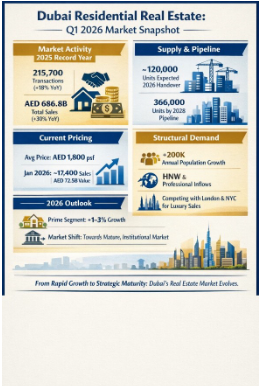
There is, unquestionably, a shift underway. Price growth is moderating from the extraordinary highs of 2023 to 2025, and supply is rising meaningfully. It is the evolution of a young global city into a stable, institutional-grade housing market.
At its core, Dubai’s residential demand is demographic, not cyclical. The emirate’s population is expected to approach roughly 4.2 million by the end of 2026, supported by sustained annual growth of around 5 to 6%. This is reinforced by continued inflows of high-net-worth individuals and global professionals, creating a structural demand floor, particularly in prime and villa segments.
This migration story is not accidental. Dubai has become a magnet for entrepreneurs, wealth creators and multinational talent, attracted by tax efficiency, infrastructure quality and regulatory clarity. Recent years have seen global business registrations surge, particularly in financial services and wealth management sectors, reinforcing the city’s position as a global capital hub rather than a purely regional one.
The supply narrative, however, is real. Large delivery pipelines, particularly apartment-heavy, are expected through 2026. This will likely create segmentation: prime villas and branded residences remain supply-constrained, while mid-market apartments face price stabilisation and selective corrections. Analysts broadly expect 2026 to represent market normalisation rather than contraction, with gains continuing but at a slower, more sustainable pace. Interest rates and global capital flows add another layer. Even with mortgage costs having edged higher globally, demographic pressure and wealth inflows continue to sustain housing demand. The UAE’s safe-haven status strengthened by geopolitical volatility elsewhere continues to channel capital and talent into Dubai, reinforcing long-term housing demand.
The most important shift is psychological. Dubai is no longer viewed as a cyclical trading market. It is increasingly seen as a place to live, build businesses and hold multi-generational wealth. Population growth alone is creating housing pressure that supports long-term price stability, even as supply expands.
The outlook, therefore, is not about whether Dubai real estate will grow, but how it will mature. Expect moderation, segmentation and greater institutional participation. In global real estate terms, Dubai is moving from momentum to permanence and that is the real story of 2026.
