



South Korea Real Estate Global Market Insights
South Korea has a highly developed real estate market, led by major cities such as Seoul, Busan, and Incheon. Housing demand is especially strong in Seoul and the surrounding metropolitan area due to limited land, employment opportunities, and well-connected public transport. The market includes apartments, landed homes, commercial buildings, and rental properties, with apartments being the most common housing choice. Property prices and transaction activity are influenced by interest rates, government housing policies, population trends, and local economic conditions.
Table of contents
- TL;DR
- Introduction
- What Makes South Korea an Attractive Real Estate Investment Destination?
- How Is South Korea’s Economy Performing Right Now?
- What’s Happening in South Korea’s Property Market in 2026?
- How Much Can You Earn From Property Investment in South Korea?
- Where Are the Best Places to Invest in South Korea Right Now?
- What Do Experts Say About the Market?
- Can Foreigners Buy Property in South Korea? What Are the Rules?
- Frequently Asked Questions (FAQs)
Key takeaway
- National prices are rising: South Korea’s annual house-price growth reached 2.6% in June 2026.
- Seoul remains less affordable: Its Housing Affordability Index reached 179.3 in Q1 2026, compared with 61.5 nationally.
- The price gap is substantial: A Seoul apartment averaged about ₩1.2 billion in Q1 2026, while the national apartment average was about ₩650 million.
- Prime Seoul prioritizes long-term value: High purchase prices make its strongest districts more suitable for liquidity and capital preservation than high monthly yield.
- Higher-income opportunities exist elsewhere: Selected areas in Incheon, Bucheon, Pyeongtaek, and university-linked districts show stronger indicative yields.
- Foreign ownership is permitted: Foreigners can generally own residential property, commercial assets, and land, but permit-zone and occupancy requirements may restrict the intended use.
TL;DR
The South Korean real estate market is growing, but Seoul and selected Capital Region locations are outperforming many regional cities. Seoul is stronger for liquidity and long-term value, while parts of Incheon, Pyeongtaek, Bucheon, and other employment-led markets may offer better rental-income potential. Foreigners can own Korean property, including land, but permit-zone, occupancy, financing, reporting, and tax rules must be checked before buying.
Introduction
South Korea’s property market can feel like a K-drama: fast-moving, full of plot twists, and completely different from one neighborhood to the next. The investment logic becomes clearer once Seoul’s scarcity-led market is separated from regional, tourism, and employment-driven cities. This market insight explains prices, returns, economic conditions, expert views, and foreign-buyer rules with full clarity.
What Makes South Korea an Attractive Real Estate Investment Destination?
South Korea attracts investors through its advanced economy, major technology companies, modern infrastructure, dense urban centers, and a framework for direct foreign ownership. It also offers different investment paths, ranging from prime Seoul apartments to employment-linked rental properties and tourism-focused coastal assets.
Why Does South Korea Appeal to International Investors?
One major advantage is the relatively open foreign ownership system. Foreign buyers can generally hold real estate directly rather than using a local nominee. Property ownership does not automatically provide residency, but a standard residence visa is not normally required simply to own property.
The market also has clear demand drivers. Seoul has corporate, educational, financial, and cultural demand. Pangyo and Suwon benefit from technology employment. Pyeongtaek combines military and semiconductor activity. Busan and Jeju offer tourism exposure, while Incheon is supported by the airport, logistics, biopharma, university, and international business activity.
Why Is Seoul the Main Property Market?
Seoul remains South Korea’s primary property market because it concentrates jobs, household wealth, universities, sought-after schools, corporate headquarters, transport links, and international demand. Prime districts such as Gangnam, Seocho, Songpa, and Yongsan also have limited land and strong resale recognition.
This supports liquidity, but the trade-off is clear. Buyers pay much more to enter the market, and rental income is usually low relative to the purchase price.
How Do Technology and Industry Create Housing Demand?
A sound property investment needs a lasting reason for people to live nearby.
Pangyo attracts technology and startup workers. Suwon benefits from Samsung-linked employment. Pyeongtaek draws military personnel, contractors, industrial workers, and semiconductor employees. Daejeon is supported by universities and research institutions, while Ulsan and Cheongju depend more on manufacturing, logistics, and technology employment.
What Are the Main Advantages and Limitations?
| Investment factor | Why is it attractive | Main limitation |
|---|---|---|
| Seoul demand | Strong jobs, schools, resale activity, and limited prime supply | High purchase prices and low yields |
| Foreign ownership | Direct ownership is generally permitted | Reporting and location rules apply |
| Economic clusters | Technology, research, logistics, military, and industry support tenant demand | Some cities rely heavily on a few employers |
| Transport investment | Better connections can widen the tenant and buyer pool | Expected gains may already be reflected in prices |
| Multiple city strategies | Investors can target growth, income, tourism, or value | Regional performance varies sharply |
Metric 1
Metric 2
Metric 3
Metric 4
Metric 5
IQI Global helps international buyers compare South Korean properties and locations based on their budget, intended use, holding period, and tenant profile. Contact our team now to learn more about South Korean properties.
How Is South Korea’s Economy Performing Right Now?
South Korea’s economy remains supported by technology, manufacturing, and semiconductor activity, although borrowing costs, household debt, inflation, and international risks continue to influence property demand.
| Economic pillar | Contribution | Export Value |
|---|---|---|
| Manufacturing | 65.6% | US$448.8 billion |
| Technology and ICT goods | 13.6% | US$93.1 billion |
| Semiconductors | 20.8% | US$141.9 billion |
Metric 1
Metric 2
Metric 3
Source: World Bank, Department of Commerce, Invest Korea (ICT, Semiconductor)
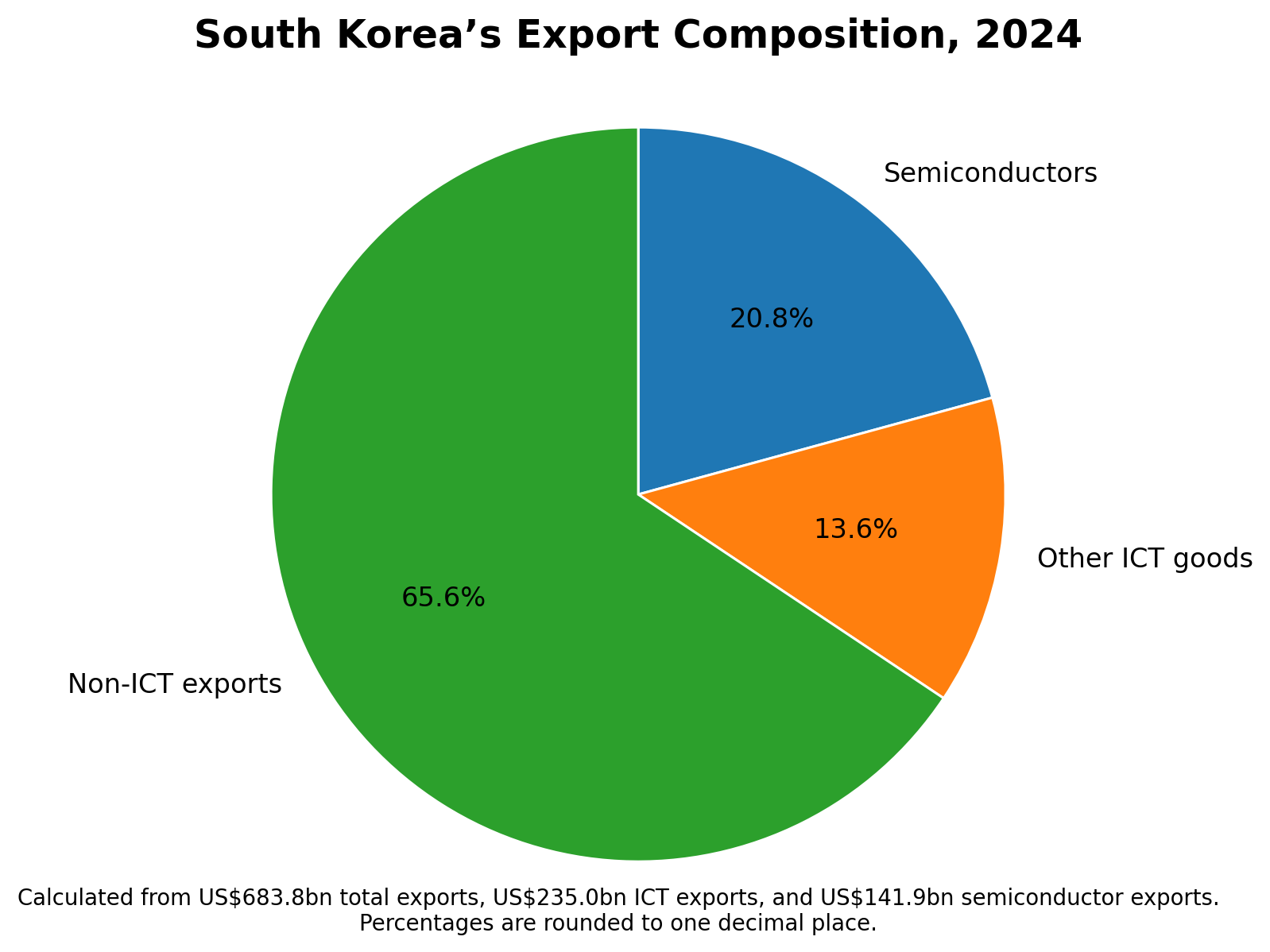
Image generated by AI
What Is Supporting Economic Growth?
The Wall Street Journal reported that South Korea had raised its 2026 growth and inflation forecasts. Separate reporting linked semiconductor clusters, stock-market gains, and employee bonuses with improved housing-market expectations.
The housing link is straightforward. Strong corporate earnings, employment growth, bonuses, and investment gains can help households build deposits and down payments. This is especially relevant around semiconductor and technology clusters.
Global Property Guide cited an IMF projection of 1.9% economic growth in 2026 and 2.1% in 2027. It also reported inflation of 2.6% in April 2026.
How Are Interest Rates Affecting Property Buyers?
Housing finance data indicate an average housing loan interest rate of 4.3% in Q1 2026. The national Housing Affordability Index rose to 61.5, while Seoul reached 179.3. A higher index represents a heavier mortgage burden relative to household income.
| Housing-finance indicator | Q1 2026 |
|---|---|
| National Housing Affordability Index | 61.5 |
| Seoul Housing Affordability Index | 179.3 |
| Busan Housing Affordability Index | 61.3 |
| Incheon Housing Affordability Index | 65.6 |
| Jeju Housing Affordability Index | 70.7 |
| Housing loan interest rate | 4.3% |
Metric 1
Metric 2
Metric 3
Metric 4
Metric 5
Metric 6
Source: Houstat
The data shows why Seoul's affordability is a more severe problem than affordability in many regional markets. Demand can remain strong even as fewer average households can comfortably afford a purchase.
Why Does Household Debt Matter?
High household debt in South Korea makes the housing market sensitive to changes in credit rules and interest rates. Regulators use loan-to-value and debt-service controls to limit highly leveraged borrowing and reduce financial risk.
A loan-to-value ratio limits borrowing based on the property’s value. A debt service ratio compares required debt payments with the borrower’s income. The exact limits depend on location, buyer status, property type, loan structure, and current policy.
For investors, price growth and affordability are separate issues. Prices can rise in areas where wealthy households compete for a limited supply, even when many average buyers cannot obtain enough financing.
What’s Happening in South Korea’s Property Market in 2026?
The South Korea property market outlook is positive at the national level but sharply divided. Seoul and selected Capital Region markets are growing faster, while several regional cities remain exposed to excess supply, population pressure, and weaker resale demand.
How Are National House Prices Moving?
South Korea’s annual house-price growth reached 2.6% in June 2026. Global Property Guide also reported a 2.35% national annual increase in April 2026, compared with 9.56% in Seoul.
These figures show why a national index cannot fully explain the market. Moderate national growth can occur alongside rapid gains in Seoul and weaker performance elsewhere.
What Is Happening to Seoul Apartment Prices?
The average Seoul apartment price was about ₩1.2 billion in Q1 2026, with an average Jeonse deposit of roughly ₩620 million. The estimated national average for apartments was around ₩650 million.
People in their thirties accounted for 40.9% of Seoul home purchases from January through May 2026, the highest share reported in the Seoul Economic Daily.
A separate survey found that 75% of respondents expected Seoul home prices to rise. The survey linked this expectation with concern about the limited future housing supply.
Why Are Seoul Prices So Resilient?
The Seoul property market is supported by limited listings for sale, strong preference for apartments, scarce central land, major employment centers, sought-after schools, and redevelopment expectations.
Rental pressure also matters. The Korea Real Estate Board’s Integrated Rent Index increased by 2.20% year-on-year in April 2026. Jeonse deposits rose 2.02%, while monthly rents rose 2.27%.
Higher rents and deposits can encourage households with enough capital to compare renting with buying. This does not make homes affordable, but it can strengthen purchase demand among better-funded buyers.
Why Are Seoul Prices So Resilient?
The Seoul property market is supported by limited listings for sale, strong preference for apartments, scarce central land, major employment centers, sought-after schools, and redevelopment expectations.
Rental pressure also matters. The Korea Real Estate Board’s Integrated Rent Index increased by 2.20% year-on-year in April 2026. Jeonse deposits rose 2.02%, while monthly rents rose 2.27%.
Higher rents and deposits can encourage households with enough capital to compare renting with buying. This does not make homes affordable, but it can strengthen purchase demand among better-funded buyers.
Is South Korea Facing a Housing Shortage?
South Korea faces different supply problems across regions. Seoul has a shortage of desirable housing, while parts of Daegu, Busan, and Gwangju have faced excess supply or stagnant prices.
Redevelopment can add housing in established districts, but the process requires planning, approvals, resident agreements, relocation, demolition, financing, and construction. New homes, therefore, take years to reach the market.
South Korea Property Market Snapshot
| Market indicator | Period | Value |
|---|---|---|
| National house-price growth | June 2026 | 2.6% year on year |
| National residential-price growth | April 2026 | 2.35% year on year |
| Seoul residential price growth | April 2026 | 9.56% year on year |
| Average Seoul apartment price | Q1 2026 | About ₩1.2 billion |
| National average apartment price | Q1 2026 | About ₩650 million |
| Average Seoul Jeonse deposit | Q1 2026 | About ₩620 million |
| Buyers in their thirties as a share of Seoul purchases | January-May 2026 | 40.9% |
| Survey respondents expect Seoul prices to rise | 2026 survey | 75% |
Metric 1
Metric 2
Metric 3
Metric 4
Metric 5
Metric 6
Metric 7
Metric 8
Source: CEIC, Global Property Guide, Seoul Homes, Seoul Economic Daily, The Chosun Daily
South Korean property grows rapidly, and it didn't wait for anyone. Approach the IQI team now and get a free consultation!
How Much Can You Earn From Property Investment in South Korea?
Property returns depend on the purchase price, rent, deposit structure, vacancy, costs, and resale value. Prime Seoul normally offers stronger liquidity and long-term appreciation potential, while lower-priced employment and student markets may provide better cash flow.
What Is the Average Rental Yield?
Numbeo estimated a national gross rental yield of 0.96% in city centers and 1.19% outside city centers on July 12, 2026. Its price-to-rent ratios were 104.52 in city centers and 84.23 outside them.
| National property indicator | July 12, 2026 |
|---|---|
| Gross rental yield, city center | 0.96% |
| Gross rental yield, outside center | 1.19% |
| Price-to-rent ratio, city center | 104.52 |
| Price-to-rent ratio, outside center | 84.23 |
| One-bedroom rent, city center | $530.75 per month |
| One-bedroom rent, outside the center | $366.51 per month |
| Purchase price, city center | $1,324.36 per m² |
| Purchase price, outside center | $694.03 per m² |
Metric 1
Metric 2
Metric 3
Metric 4
Metric 5
Metric 6
Metric 7
Metric 8
Source: Numbeo as of 12 July 2026
Which Areas Offer Higher Indicative Yields?
| Area | Indicative gross yield | Main tenant driver |
|---|---|---|
| Sillim-dong, Gwanak-gu | 3.5%-4.5% | Students and affordable housing |
| Changcheon-dong, Seodaemun-gu | 3.3%-4.3% | University demand |
| Bupyeong-dong, Incheon | 4.0%-5.5% | Industrial and office workers |
| Sosa-gu, Bucheon | 4.0%-5.2% | Commuters and lower entry prices |
| Pyeongtaek | About 5.76% for the selected two-bedroom properties | Military and industrial tenants |
Metric 1
Metric 2
Metric 3
Metric 4
Metric 5
Source: Bambooroutes & Jarnias Cyril
These estimates are screening figures, not promised returns. Investors still need to verify the building, lease terms, deposit, management fee, vacancy history, taxes, and likely resale demand.
What Is the Difference Between Jeonse, Wolse, and Banjeonse?
| Rental system | Deposit | Monthly rent | Investor cash flow | Main risk |
|---|---|---|---|---|
| Jeonse | Very high | Little or none | Large refundable deposit, but little monthly income | The deposit must be repaid |
| Wolse | Lower | Regular payment | Clearer monthly cash flow | Vacancy and tenant turnover |
| Banjeonse | Medium to high | Reduced payment | Mix of deposit and rent | More complex contract terms |
Metric 1
Metric 2
Metric 3
The Jeonse deposit system traditionally allows the landlord to use a large tenant deposit during the lease. The deposit typically ranges from 50% to 80% of the property's value and must be returned at the end of the lease.
The Wolse monthly rental system produces clearer, more predictable recurring cash flow because the tenant pays rent along with a smaller deposit. Monthly-rent contracts represented 68.6% of nationwide new lease registrations and 70.5% in Seoul in Q1 2026.
The Banjeonse rental system sits between Jeonse and Wolse. It uses a larger deposit than a typical Wolse agreement and a lower monthly payment.
How Should Investors Calculate Real Returns?
Suppose a buyer pays ₩400 million for a unit and receives ₩1.5 million per month in rent.
Annual rent would be ₩18 million. Dividing that by the purchase price gives a hypothetical gross yield of 4.5%. The investor must then deduct maintenance, repairs, insurance, agency fees, vacancy, management charges, taxes, and financing costs.
The more useful measure is net income divided by total invested capital. Gross rent alone does not show what the owner actually keeps.
What Can Reduce Rental Income?
The main rental-return risks include:
Vacancy between tenancies
The need to repay a large Jeonse deposit
Property management and maintenance costs
Seasonal tourism demand in Busan and Jeju
Short-term rental licensing and use restrictions
Dependence on one employer or industry
Foreign-exchange movements
Limited resale demand in smaller markets
Where Are the Best Places to Invest in South Korea Right Now?
The best city depends on the investment objective. Seoul leads for long-term value and liquidity. Incheon and Pyeongtaek offer stronger income stories. Busan and Jeju suit buyers prepared to manage tourism and seasonal risks.
Is Seoul Best for Long-Term Capital Growth?
For capital preservation, the strongest Seoul districts include Gangnam, Seocho, Songpa, and Yongsan. These locations benefit from scarcity, schools, corporate access, prestige, and established resale demand. Mapo and Seongsu offer younger tenant bases and redevelopment-led growth stories, while outer districts provide lower entry prices.
Seoul is less suitable for investors focused only on monthly income. It better suits buyers with a longer holding period, a larger budget, and a need for resale liquidity.
Is Incheon Better for Rental Income?
Incheon and Songdo provide a more balanced income-and-growth strategy. Prices are generally lower than in central Seoul, while demand comes from logistics, airport activity, biopharma, universities, international institutions, and expatriate households.
Bupyeong may suit yield-focused buyers, while Songdo is more closely linked to modern infrastructure and international business. Investors still need to compare individual neighborhoods because demand is uneven.
Is Busan a Good Alternative to Seoul?
Busan offers coastal diversity, a port economy, tourism, universities, and lower overall entry prices than in prime Seoul. Haeundae, Gwangalli, and Suyeong have the strongest appeal for lifestyle and tourism.
The main risks are seasonality, short-term rental rules, older housing stock, and excess supply in weaker districts.
Is Jeju Suitable for Tourism Investment?
Jeju is best suited to tourism and lifestyle property, especially for buyers who may also use the home themselves. Its appeal comes from natural scenery, resorts, visitor demand, and island living.
Its limits include seasonal income, a smaller employment base, dependence on transport, and weaker resale activity than in Seoul. Buyers should calculate annual occupancy rather than relying on peak-season rates.
Which Other Cities Deserve Attention?
Pangyo and Seongnam: Technology employees and professional tenants
Suwon: Corporate and family demand linked to technology employment
Daejeon: Universities, research institutions, and stable tenant demand
Pyeongtaek: Military, contractor, industrial, and semiconductor demand
Ulsan: Manufacturing employment and relatively affordable housing
Cheongju: Logistics, semiconductors, and lower entry prices
Investment Location Comparison
| City or area | Best suited to | Main demand engine | Main risk |
|---|---|---|---|
| Seoul | Capital growth and liquidity | Jobs, education, scarcity, and wealth | High prices and low yields |
| Incheon and Songdo | Income and medium-term growth | Airport, logistics, biopharma, and international institutions | Uneven demand |
| Busan | Tourism and coastal diversification | Port economy and visitors | Seasonality and excess supply in weaker areas |
| Pangyo and Seongnam | Professional rental demand | Technology employment | High competition and entry prices |
| Pyeongtaek | Rental income | Military and semiconductor activity | Dependence on major employers |
| Jeju | Lifestyle and tourism | Visitor demand | Seasonality and limited economic diversity |
| Ulsan | Industrial rental demand | Manufacturing | Exposure to industrial cycles |
| Cheongju | Affordable value strategy | Logistics and semiconductors | Lower resale liquidity |
Metric 1
Metric 2
Metric 3
Metric 4
Metric 5
Metric 6
Metric 7
Metric 8
Interested in one of South Korea's hotspots and want to buy a house there? We can help you! Talk with the IQI team to start your property buying journey now!
What Do Experts Say About the Market?
Experts describe a polarised market in which Seoul remains strong, redevelopment attracts buyers, and regional cities require greater care.
What Do Experts Expect From Seoul Prices?
Kim Je-kyung
CEO and chief consultant at Toomi Real Estate Consulting
Kim Je-kyung of Toomi Real Estate Consulting forecast that Seoul housing prices could rise by more than 10% annually. He linked the forecast with fewer sale listings, rental pressure, and renewed buying demand.
What Do Experts Say About Redevelopment?
Kim described redevelopment as “the only surviving investment opportunities are redevelopment projects.” His view was that older housing and redevelopment rights could offer exposure to future apartment supply in heavily regulated locations.
What Do Institutional Reports Say?
CBRE Korea expects South Korea’s living sector to continue to develop as monthly rentals grow and professional investors enter housing-related sectors. It also identifies tax and policy uncertainty as barriers.
Savills Korea forecasts Seoul’s overall prime-office vacancy rate at 5% to 7% in 2026. It expected the Gangnam Business District to remain tighter at about 2% to 3%.
Newmark reported that office-investment activity in 2025 expanded beyond Seoul’s traditional business districts into Bundang-Pangyo, Seongsu-Seoul Forest, Magok, and Sangam DMC.
What Is the Overall Expert View?
The expert view is not that every Korean property will rise. Seoul’s limited supply, employment base, redevelopment pipeline, and rental pressure support selected assets. Regional investment requires much closer attention to local jobs, population trends, housing supply, and future resale demand.
Can Foreigners Buy Property in South Korea? What Are the Rules?
Yes. Foreigners can buy property in South Korea, including apartments, houses, commercial premises, and land. The main challenge is ensuring that the location, funding route, property type, and intended use comply with local rules.
What Can Foreign Buyers Own?
Foreign individuals and companies can generally own residential and commercial property with rights close to those of Korean citizens. They can sell, rent, or develop it, subject to zoning, tenancy, tax, and registration laws.
Some military, cultural, ecological, strategic, island, and border locations may require approval. Property ownership also does not automatically provide residency.
What Are the Steps to Buy Property?
A foreign buyer should follow this seven-step process:
Choose the location and property type.
Check whether the property is in a land transaction permit zone.
Confirm whether owner occupancy is required.
Verify title, zoning, building records, and registered debts.
Arrange cash or mortgage financing.
Complete foreign-exchange and funding reports.
Register ownership and pay the required taxes and fees.
Registration in the land register legally establishes ownership. A signed contract and payment alone do not complete the ownership process.
What Is a Land Transaction Permit Zone?
A land transaction permit zone requires prior approval for certain property purchases. In designated parts of the Seoul Metropolitan Area, the system is intended to restrict speculative residential buying.
Restrictions introduced in August 2025 covered Seoul, 23 cities in Gyeonggi Province, and seven districts in Incheon. Affected foreign buyers must obtain permission, move into the property within four months, and occupy it continuously for at least two years. Foreign funding sources must be declared within 30 days of signing.
Non-compliance can result in a fine of up to 10% of the property's value and possible cancellation. The cited restriction excludes commercial properties and officetels. Buyers must confirm the rules that apply on the contract date because permit designations can change.
Can Foreigners Get a Mortgage?
Foreigners can obtain a South Korean mortgage, but banks assess residency, visa status, Korean income, credit history, property value, employment, overseas documents, and existing debt.
Foreign-buyer loan-to-value ratios can be 50% to 70%, down payments are commonly between 30% and 40%, and foreign-borrower rates are around 3.5% to 5.5%. These are indicative ranges, not guaranteed bank offers.
Non-residents may face greater difficulty because lenders must verify overseas income, tax records, and identity documents. Some buyers, therefore, use cash or financing from their home country.
What Taxes Apply?
Foreign buyers may face acquisition tax, registration costs, stamp duty, legal fees, agency fees, annual holding tax, rental income tax, and capital gains tax when selling. The amount depends on the property, location, ownership structure, holding period, and taxpayer position.
Residential acquisition tax can range from 1% to 3%, with rates up to 12% in certain cases, depending on value, property type, ownership count, and local regulations. It also estimates ordinary buyer-side acquisition costs at roughly 3.5% to 5%.
Capital gains tax applies when the property is sold. The final amount depends on the gain, holding period, residence conditions, number of homes, ownership structure, and current policy.
Foreign-Buyer Due-Diligence Checklist
| Issue | What to verify |
|---|---|
| Location | Is the property inside a permit or restricted zone? |
| Occupancy | Must the buyer live in the home? |
| Property type | Is it an apartment, officetel, commercial unit, house, or land? |
| Funding | Must overseas funds be reported? |
| Mortgage | Will a Korean bank accept the buyer’s income and status? |
| Registration | Have title and ownership filings been completed? |
| Taxes | What acquisition, holding, rental, and disposal taxes apply? |
| Rental use | Is the planned long-term or short-term rental legally permitted? |
Metric 1
Metric 2
Metric 3
Metric 4
Metric 5
Metric 6
Metric 7
Metric 8
IQI Global can connect international buyers with property opportunities and local professionals familiar with cross-border purchases. If you are interested in South Korean property, connect with the IQI team now to take the first step in your international property-buying journey.
Frequently Asked Questions (FAQs)
1. Is South Korean real estate a Good Investment in 2026?
South Korean real estate can be a good investment when the location aligns with the buyer’s goals. Seoul is stronger for liquidity and long-term value, while Incheon, Pyeongtaek, and selected employment hubs may suit income investors. High prices, low national yields, household debt, regional excess supply, and regulation remain important risks.
2. Can Foreigners Buy Apartments in South Korea?
Yes. Foreign buyers can generally own apartments, houses, commercial property, officetels, and land. Restricted locations may require approval, and designated Seoul Metropolitan Area purchases may include occupancy requirements. Ownership does not automatically provide a residence visa.
3. How Much Does Property Cost in South Korea?
A Seoul apartment averaged about ₩1.2 billion in Q1 2026, compared with a national apartment average of roughly ₩650 million. Prices vary sharply by city, district, property type, size, condition, and transport access.
4. Why Are Seoul Apartment Prices So High?
Seoul apartment prices are supported by concentrated employment, sought-after schools, transport links, limited central land, redevelopment expectations, and strong buyer preference for apartments. New supply takes years to complete in established districts.
5. What Is the Difference Between Jeonse, Wolse, and Banjeonse?
Jeonse uses a large refundable deposit with little or no monthly rent. Wolse combines a smaller deposit with a monthly rent. Banjeonse uses a medium-to-large deposit and a lower monthly payment.
6. Which South Korean City Offers the Best Rental Yield?
There is no single winner. Selected Incheon and Bucheon districts have indicative gross yields of about 4% to 5.5%, while Pyeongtaek was estimated at about 5.76% for certain two-bedroom properties. Net returns depend on vacancy, deposits, costs, taxes, and resale demand.
7. What Taxes Do Foreign Property Buyers Pay?
Foreign buyers may pay acquisition tax, registration costs, professional fees, holding taxes, rental-income tax, and capital gains tax. Rates vary by property value, location, ownership count, holding period, and taxpayer position.
Need help to get started
Let our agents help you find the ideal land for you
Disclaimer:
The information provided is for general market insight only and does not constitute financial, investment, tax, or legal advice. IQI does not solicit or compel any purchase or investment. Property values and rental returns may fluctuate; please conduct your own due diligence and consult licensed professionals before making any decisions.
References & Citations
- Best areas to buy property in South Korea (2026) – BambooRoutes (January 17, 2026)
- Buying and owning a property as a foreigner in South Korea (2026) – BambooRoutes (July 3, 2026)
- 2026 Korea real estate market outlook – CBRE (January 15, 2026)
- Housing finance index – Houstat
- South Korea house prices growth – ISI Markets CEIC
- 2026 Korea office capital markets: Conditions & trends – Jang, J., & Pritchard, J. of Newmark
- Buying property in South Korea: Complete guide for foreigners – Jarnias, C (January 14, 2026)
- Best neighborhoods for real estate investment in South Korea: Seoul, Busan, Incheon – Jarnias, C (January 15, 2026)
- Most popular neighborhoods for expats in South Korea: Complete guide – Jarnias, C (April 29, 2026)
- Semiconductor clusters and stock rally lift South Korea housing outlook – Jeong, M of Chosun Biz (July 14, 2026)
- Repeated short-term market curbs fail to tame housing market – Jin, M.-J of Korea JoongAng Daily (April 11, 2026)
- South Korea raises 2026 growth, inflation forecasts – Jun, K of The Wall Street Journal (July 13, 2026)
- Top 10 Korea real estate investment cities guide – Juwai Asia (May 26, 2026)
- Seoul home buying by thirtysomethings tops pandemic-era peak – Kim, K.-M of Seoul Economic Daily (July 5, 2026)
- Seoul housing prices to surge over 10% amid redevelopment focus – Kim, Y.-J of The Chosun Daily (June 22, 2026)
- Real estate 2026 - South Korea. Chambers and Partners – Lee & Ko (May 7, 2026)
- 2026 Korea office market outlook – Lee, C., & Hong, J of Savills Korea (March 12, 2026)
- 8 in 10 expect home price surge amid supply cliff – Lee, J of The Chosun Daily (March 12, 2026)
- South Korea’s housing crisis explained – Leyden, D of LGIU (July 1, 2026)
- South Korea real estate market size analysis | 2024–2030 – Next Move Strategy Consulting (June 4, 2026)
- Property prices in South Korea – Numbeo (July 12, 2026)
- South Korea’s residential property market analysis 2026 – Nussupbekova, T of Global Property Guide
- South Korea real estate investment 2026 | Where to buy property in Seoul & beyond – Patel, K of Chestertons (April 9, 2026)
- Average home prices in Seoul (by district) – Seoul Homes (July 15, 2026)
Share on
Want to discuss further?
Other Countries








Why Do Smart Investors Choose IQI as Their Real Estate Partner?
Get your financial planning right by using our simple mortgage loan calculator to find out estimates of monthly instalments, applicable interest rates and the principal amount that best suit your financial capacity
Exclusive market insights
powered by on-ground teams in 30+ countries
Data-driven strategies
using our proprietary IQI Atlas system for returns, yields, and forecasting
Award-winning agents
trained to serve local and international investors with integrity and expertise
Secure investment processes
with verified partners, legal guidance, and full transparency
Diverse project portfolios
across residential, commercial, and international markets

