


































Newsletter
Keep yourself update with our current news for Juwai IQI

Juwai IQI Global Real Estate Newsletter for April 2026
The April 2026 global real estate newsletter highlights a global property market that is becoming increasingly selective, shaped by shifting demand patterns, geopolitical influences, and evolving economic conditions.In Australia, the market is showing a clear split. While Sydney and Melbourne remain relatively flat, cities like Perth, Brisbane, and Adelaide are leading growth, supported by strong demand and limited housing supply. This reflects a broader trend where investors are moving towards more affordable and high-growth markets rather than traditional hotspots.Across Asia, market dynamics continue to diverge. Hong Kong is seeing signs of recovery with improving office demand and stable residential prices, while Vietnam faces pressure from rising mortgage rates that are slowing buyer activity. At the same time, large-scale urban developments across Vietnam highlight strong long-term growth potential.In Southeast Asia, Malaysia is strengthening investor confidence through regulatory reforms that improve transparency and buyer protection, while Thailand’s market is adjusting with rising supply, particularly in the condominium segment. Singapore, on the other hand, has seen a rebound in new home sales, driven by fresh project launches and continued demand in suburban areas.Globally, investor attention is increasingly shifting towards markets with strong fundamentals. Greece is emerging as a strategic safe haven with rising capital inflows, while Dubai continues to demonstrate long-term resilience supported by pro-investment policies and consistent demand. Saudi Arabia is also gaining traction, driven by Vision 2030 reforms and large-scale developments that are transforming its real estate landscape.Meanwhile, Canada’s housing market is becoming more balanced as inventory rises and prices adjust, offering buyers greater choice. Pakistan is experiencing short-term caution due to geopolitical tensions, although this may create entry opportunities for long-term investors. India is seeing growing demand for luxury and land-based developments, reflecting a shift in preferences among high-net-worth buyers.From a global perspective, the economic outlook remains stable but uncertain. Inflation is easing and interest rates are expected to gradually decline, supporting investor confidence. However, geopolitical risks and energy market volatility continue to influence investment strategies, with real estate increasingly viewed as a long-term, stable asset within diversified portfolios.Overall, global property markets in 2026 are no longer moving in a single direction. Instead, success depends on identifying the right markets, understanding local dynamics, and positioning early in areas with strong fundamentals and long-term growth potential.Discover More HereDownload
13 April

Juwai IQI Global Real Estate Newsletter for March 2026
The February 2026 global real estate newsletter highlights a shift toward a more balanced and mature property market worldwide. While inflation is easing and interest rates are stabilising in many economies, investment activity is increasingly focused on markets supported by strong demographics, infrastructure investment, and policy reforms. Regions such as the Middle East and Southeast Asia continue to attract global capital due to population growth, urban development, and economic diversification. Rather than speculative growth, 2026 is shaping up to be a year for strategic and disciplined property investment.Several regional markets show resilient housing demand despite varying economic pressures. In Australia, home values rose modestly in early 2026 due to limited housing supply and steady buyer demand, though affordability constraints may slow future growth. Greece’s capital, Athens, is transitioning from a recovery phase to a stable investment market with steady price growth and strong foreign buyer participation. Meanwhile, Hong Kong’s property sector is gradually recovering, with improving office absorption and steady residential sales despite slightly elevated vacancy levels.Across Asia, property markets are experiencing structural shifts driven by urbanisation and infrastructure development. Vietnam’s major cities, Ho Chi Minh City and Hanoi, are seeing rapidly rising apartment prices, with premium developments attracting strong demand due to integrated amenities and modern living environments. Bali’s property market remains attractive for international investors due to strong tourism recovery and limited land supply, though most foreign buyers invest through long-term leasehold arrangements. In Malaysia, government policy such as the extended stamp duty exemption for homes below RM500,000 is helping first-time buyers enter the market and supporting activity in the affordable housing segment.In the Middle East, real estate markets continue to benefit from long-term economic transformation and global migration trends. Saudi Arabia’s property sector is expanding under Vision 2030 initiatives, with increasing investor interest in master-planned communities and infrastructure-linked developments. Dubai’s residential market is evolving into a more mature phase following several years of rapid growth, supported by population inflows, business migration, and strong demand from global wealth investors. Overall, global property markets in 2026 are moving toward stability and long-term value creation, with investors prioritising locations that offer sustainable economic fundamentals and infrastructure-driven growth.Discover More HereDownload
5 March
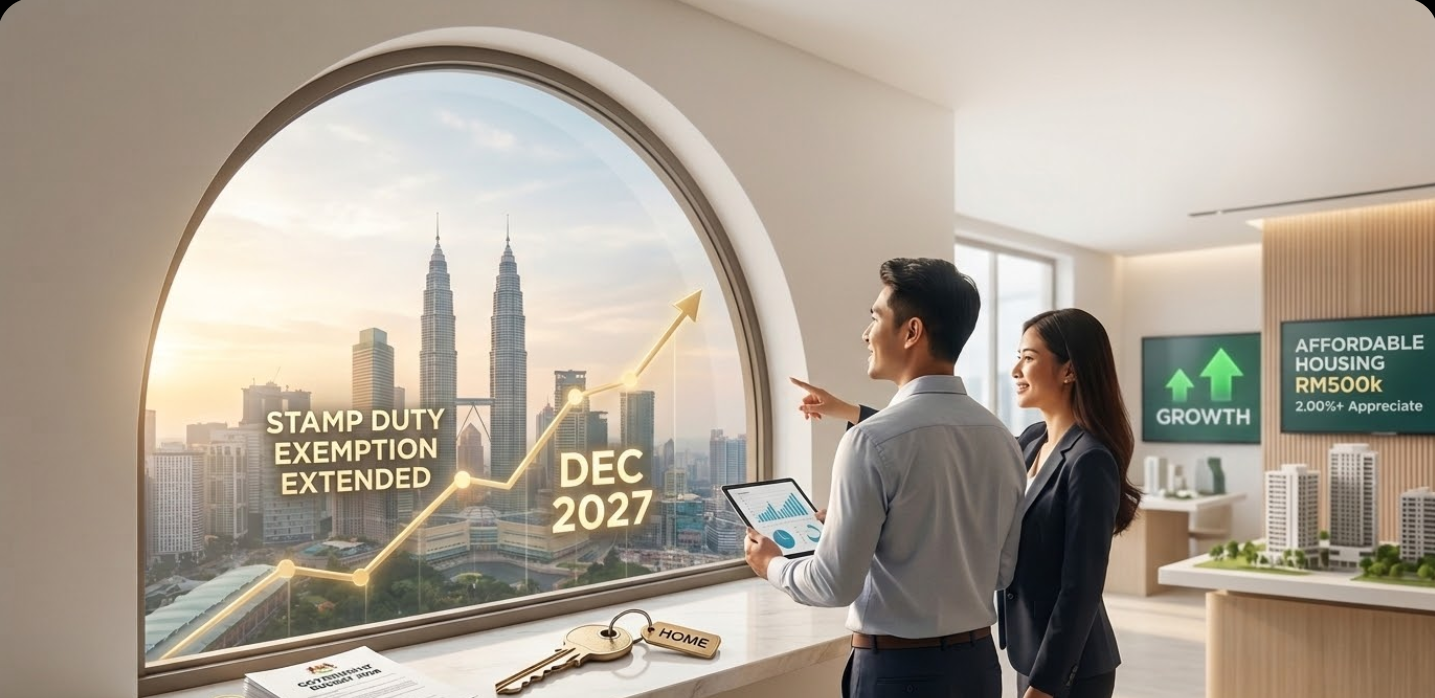
Stamp Duty Extension: A Window of Opportunity
As we highlighted in our recent guide on the three financial weapons of 2026, the biggest hurdle for first-time homebuyers is not always the monthly repayment. It is the upfront cash required to sign the papers. Recognizing this, the government's move in Budget 2026 to extend the 100% stamp duty exemption is a strategic gamechanger. Here is why this extension creates a critical window of opportunity for you. 1. The Relief is Significant (and Extended to 2027) The government has officially extended the full stamp duty exemption for first-time homebuyers on properties priced below RM 500,000 until December 31, 2027. This is immediate cash preservation. On a RM 500,000 home, the stamp duty for the Memorandum of Transfer (MOT) and loan agreement would typically cost you around RM 11,000. With this exemption, that RM 11,000 stays in your pocket. This is money that can now be used for renovation, furniture, or an emergency fund. 2. Targeting the Market’s Sweet Spot This policy is not random; it is precise. Data shows that the sub-RM 500,000 segment currently accounts for 77.7% of all residential transactions in Malaysia. By focusing on this tier, the initiative does two things. First, it supports many Malaysians who are looking for affordable, mid-market homes. Second, it encourages the absorption of existing property stock, ensuring the housing market remains liquid and active. 3. Why You Shouldn't Wait While the extension runs until the end of 2027, the wider economic context matters. Property prices in the affordable segment are likely to appreciate as demand surges due to this incentive. Furthermore, Bank Negara Malaysia (BNM) reports an upward trend in affordable housing prices of around 2% to 4% annually. Waiting until the deadline approaches could mean facing higher property prices, negating the savings from the stamp duty waiver. The "window of opportunity" is not just about the tax break; it is about securing a property while prices are still stable in early 2026. Conclusion Budget 2026 has removed a significant barrier to entry. If you are a first-time buyer eyeing a property under RM 500,000, the government has effectively removed your entry barrier. The path is clear. Now is the time to walk through it. Discover More HereDownload
5 March

Dubai Unlocks New Money Through Tokenisation
Dubai’s property market is experimenting with a new model that could significantly increase the number of investors and the amount of capital flowing into the emirate’s real estate sector. Instead of buying whole homes or villas, investors can now buy fractional digital shares of property using blockchain-based tokenisation. Units are sold for as little as about $545, which is a dramatic drop from the millions usually required to own a luxury home in Dubai. Kashif Ansari, co-founder and group CEO of Juwai IQI, says Dubai’s push here signals ambition to lead globally by broadening access to property investment. But he stresses that the model’s success hinges on three pillars: a steady supply of tokenised assets, expanded participation for foreign investors, and development of a truly active secondary market where shares trade continuously. Top regional media covered Kashif’s thoughts on this theme, including Gulf Today and London Stock Exchange Group-owned Zawya. From Kashif’s vantage point, tokenisation won’t replace traditional property demand. Instead, he sees it as complementary. It will expand the pool of capital without displacing institutional buyers. He points to China’s investor base as an example. Only a small fraction of Chinese can afford to purchase full properties in Dubai, but the population that could purchase tokenized shares is some 15-times larger. Discover More HereDownload
5 March

Global Economic Outlook 2026: The Power of Tech-Driven Investment
As we look toward 2026, the fusion of technology and strategic investment stands as a pivotal driver of economic growth. Nations that prioritize innovation whether in AI, renewable energy, or digital infrastructure are unlock productivity gains, foster entrepreneurship and attract global capital. From Southeast Asia’s booming digital economy to the rapid industrial upgrades across the GCC, tech-empowered investments are catalyzing higher GDP trajectories. In short, economies that harness technological investment today will lead tomorrow’s growth narrative at the macro level INVESTMENT FROM BIG TECH FIRMS Big tech plans to spend BIG on AI in 2026. Here’s how much big tech plans to spend on CAPEX in 2026 $200 Billion - Amazon $AMZN $180 Billion - Google $GOOGL $125 Billion - Meta Platforms $META $117.5 Billion - Microsoft $MSFT $20 Billion - Tesla $TSLA $13 Billion - Apple $AAPL WHAT IS WARSHONOMICS? According to Economist magazine, Kevin Warsh's dovish pivot since Donald Trump won in 2024 is staggering. Over a 20+ year career, he has pretty much always been a hawk: until now. But on his real hobby horse, unwinding QE, Warsh remains remarkably consistent. EMERGING MARKETS ARE OFF TO A FLYING START IN 2026 The MSCI EM index is up around 11% in USD terms so far this year, versus just around 2% for the MSCI US. In some ways, it feels familiar. This time last year, a falling US dollar helped EM equities strengthen as US stocks lost momentum. After the volatility around April’s “Liberation Day” tariff surprise, EMs went on to outperform the US for the full year. But this time, there’s more going on than just FX. With global investors cooling towards dollar assets again and the dollar falling sharply this week, EM momentum is accelerating. Unlike last year, structural improvements and better company fundamentals are also doing the heavy lifting. Beneath the surface, some moves have been striking: Korea: up around 28% in January, building on last year’s near-100% gain. Large-cap tech stocks tied to the global AI build-out, corporate governance reforms, and government support have attracted foreign inflows. Taiwan: another EM tech powerhouse, posting double-digit gains as demand for advanced semiconductors remains strong. Brazil: up around 21% this month. Structural reforms, prospects for lower rates, strong investor flows, and a commodities rally have all helped. The bottom line? Emerging markets are proving again in 2026 that they can be both lucky and good — with dollar weakness acting as a catalyst for improving fundamentals, stronger profits, and compelling regional stories. Discover More HereDownload
5 March

People’s Financial Guide March 2026: Navigating a Stabilizing Global Economy
Smart Growth Opportunities in a Stabilizing Global Economy As we move through March 2026, signs of stabilization in the global economy are becoming clearer. Inflation is easing in many major regions, and although growth remains modest, it is steady. Reports from the International Monetary Fund and World Bank indicate a shift from restrictive financial conditions to a more sustainable and balanced expansion. While challenges remain, the overall environment is becoming more navigable for investors and households alike. Central Banks: Cautious and Data-Driven Across developed markets, central banks are maintaining a measured and data-dependent stance. While inflation has declined, monetary authorities in regions such as Europe and Asia continue to emphasize the importance of incoming data when shaping interest rate decisions. A gradual reduction in rates is anticipated in the latter half of 2026, contingent on continued progress toward inflation targets. Investment Markets: Selective Confidence Investor sentiment is improving, but optimism remains focused rather than broad-based. Equity markets have been particularly supported by growth in innovation-driven sectors such as semiconductors, artificial intelligence, and advanced manufacturing. Rather than rallying across all industries, markets are favouring companies with strong earnings, solid fundamentals, and long-term growth prospects. At the same time, capital inflows into emerging markets especially in Asia and Latin America are gaining momentum. Favourable demographics, resilient consumer demand, and infrastructure development are enhancing their appeal as part of a globally diversified portfolio. Real Estate: Quality and Sustainability Drive Value Real estate markets around the world are showing early signs of stabilization following the adjustment to higher interest rates. Investors are concentrating on sectors with stable demand, such as multifamily housing, logistics, and digital infrastructure including data centres, which are growing in importance due to the rise of AI and cloud computing. Sustainability has emerged as a key value driver. Energy-efficient, environmentally compliant buildings are commanding higher tenant demand and demonstrating stronger value retention over time. Cities that lead in ESG standards like Singapore, London, and Tokyo are attracting institutional interest, as investors recognize the long-term performance advantages of green buildings. Commodities and Currencies: Diversification Remains Key Commodities continue to serve as an effective tool for portfolio diversification. Gold remains a preferred store of value amid geopolitical uncertainty, while oil prices are being shaped more by supply-side concerns than demand surges. In currency markets, the relative strength of emerging market currencies has increased the attractiveness of local-currency bonds and international equity exposure. This shift reinforces the importance of global diversification both as a hedge and a growth strategy. Discover More HereDownload
5 March

Where to Invest in 2026: Strategic Real Estate Growth Markets
Strategic Positioning in a Year of Selective Growth As we move through the first quarter of 2026, global real estate markets are entering a more balanced phase. Inflation has eased across most major economies, interest rates are stabilising, and capital is cautiously returning to markets where demand fundamentals remain strong. Rather than speculative expansion, this year favours disciplined investment in regions supported by demographic growth, infrastructure spending, and policy reform. The Middle East: Reform-Driven Momentum The Gulf continues to stand out as a structural growth story rather than a cyclical recovery. Dubai, UAE remains a global capital magnet. Population growth, business migration, and continued inflows from Europe, India, and Asia are supporting residential demand. While price growth has moderated from peak levels, rental yields remain competitive, particularly in mid-market and well-located family communities. Dubai’s transparent regulations, tax advantages, and strong liquidity continue to make it one of the most accessible international markets. Saudi Arabia, particularly Riyadh, is benefiting from Vision 2030 reforms and corporate relocations. Office, logistics, and residential demand are expanding alongside economic diversification. While mega-projects such as NEOM represent long-term transformation plays, Riyadh’s core residential and industrial sectors already offer exposure to real economic expansion and population growth. Southeast Asia: Demographics and Urban Expansion ASEAN markets continue to combine affordability, infrastructure upgrades, and young populations. Malaysia offers one of the region’s most balanced profiles. Kuala Lumpur provides attractive entry pricing compared to regional peers, while Johor benefits from cross-border integration with Singapore and growing industrial investment, including data centres and logistics. Vietnam remains a high-growth economy driven by manufacturing relocation and rising middle-class demand. Ho Chi Minh City and Hanoi continue to experience urban housing needs that support long-term residential fundamentals. Thailand, particularly Bangkok and Phuket, attracts both end-users and lifestyle investors. Transit-linked developments in Bangkok and resort-driven demand in Phuket offer differentiated opportunities. Bali, Indonesia continues to attract lifestyle-driven investors, with limited land supply and sustained tourism recovery supporting strong short-term rental yields and long-term capital appreciation potential in prime villa locations. India: Institutional Strength and Domestic Demand India’s property market is becoming more structured and developer quality is consolidating. Major cities such as Bengaluru and Hyderabad benefit from strong technology-sector demand, while mid-income housing across Tier-1 cities continues to show resilience supported by domestic consumption growth. Outlook 2026 is not a year for aggressive speculation. It is a year for strategic allocation. Markets with strong population growth, supply discipline, and reform-driven expansion are likely to outperform. The Middle East offers transformation momentum, Southeast Asia provides structural growth at accessible entry points, and selective European markets offer stability. For investors, the opportunity lies not in timing the cycle perfectly — but in positioning capital where long-term fundamentals remain firmly intact. Discover more hereDownload
5 March

India’s Warehousing & Logistics Real Estate Emerges as a Core Growth Engine
India’s warehousing and logistics real estate sector has entered a decisive growth phase, underpinned by structural shifts in consumption, manufacturing, and supply-chain strategy. Rapid e-commerce expansion, the rise of organised retail, and sustained government focus on infrastructure and policy reforms have collectively transformed the sector into one of the most resilient real estate asset classes in the country. Industrial and warehousing leasing across India’s top eight cities reached 36.9 million sq ft in 2025, reflecting a 16% year-on-year increase and one of the strongest performances recorded in recent years. With momentum remaining strong, gross leasing is expected to cross 60 million sq ft by year-end, setting a new benchmark for the logistics and industrial market. Demand continues to broaden geographically. While Delhi-NCR and Chennai led absorption -together accounting for nearly half of total leasing -the increasing penetration of Tier-2 locations is reshaping India’s logistics map. This decentralisation, combined with the emergence of integrated logistics parks and built-to-suit facilities, has made India’s ambition of reaching 850 million sq ft of warehousing stock by 2030 increasingly achievable. Third-party logistics (3PL) operators remained the largest occupiers, contributing roughly one-third of total demand, while engineering and e-commerce players continued to scale up operations. Notably, large-format transactions above 200,000 sq ft formed nearly 45% of total absorption, indicating strong occupier confidence and a clear shift toward consolidation and scale. With initiatives such as “Make in India,” PLI schemes, and logistics modernisation gaining traction, India’s warehousing market is well-positioned for sustained, long-term growth. Download to see insights from other country marketsDownload
4 March

