

Negotiator ∙ IQI Indonesia
Lina

About Lina
Leveraging market knowledge and negotiation skills to deliver exceptional results. Your real estate success is my priority. Ready to make your real estate dreams a reality? Let's chat. Your dream home awaits.
Lina Social Links
No social links available.
My Listings
No listings available at the moment.
Our newly launched projects
Discover the real estate properties in and around Indonesia, Indonesia. Buy apartment units, landed houses, bungalows, commercial office space, shop lots, and sub-sales with 100% confidence at IQI Global.
 Pet-friendly apartment
EleVee Residences
Jl. Jalur Sutera Bar. No.Kav. 20, Panunggangan Tim., Kec. Pinang, Kota Tangerang, Banten 15143, Indonesia
Starting from RM 518,581
Listed on April 25, 2025
 Infinity pool rooftop
The Umalas Signature
Jl. Bumbak No.156, Kerobokan, Kec. Kuta Utara, Kabupaten Badung, Bali 80361, Indonesia
Starting from RM 510,913
Listed on December 15, 2021
 Prime Bali location
Sky Stars Luxury Villas
Jl. Nusa Dua, Benoa, Kec. Kuta Sel., Kabupaten Badung, Bali 80361, Indonesia
Starting from RM 1,058,611
Listed on December 9, 2021
 Luxury development
Lavaya Residence and Resort
Jl. Telaga Waja No.5, Tj. Benoa, Kec. Kuta Sel., Kabupaten Badung, Bali 80361, Indonesia
Starting from RM 1,557,330
Listed on December 9, 2021
Mortgage Calculator
Calculate your estimated month repayment and plan your monthly expenses well.
The mortgage calculator is intended for reference only. Actual amount may vary.
Monthly Payment
Send me the mortgage calculator result

Home Loan Eligibility Calculator
Calculate your potential loan amount and assess your home buying affordability.

Rental Yield
Calculate the potential rental yield and evaluate a property's investment performance.

Down Payment Saving Plan
Create a structured savings plan and determine how much to save monthly for your down payment plan.

Malaysian Property Transaction Fees Calculator
Estimate the total transaction fees and budget accurately for your Malaysian property purchase.
IQI blog & news
Articles specifically curated for your daily digest of local and global real estate news.

28 Oct, 2026
Top 10 High-Paying Work From Home Jobs Malaysia 2026
TL;DRSolutions architects lead the list of high-paying WFH roles in Malaysia, with an estimated median of RM14,750 per month, followed by IT project managers at RM11,500. In JobStreet postings, hybrid-tagged jobs outnumbered remote-tagged jobs. Real estate negotiators offer another high-income route, combining work from home with client visits and earning commission on completed transactions. Imagine trading your morning traffic jam for an extra hour in bed. Tempting, right? The challenge is finding work-from-home jobs in Malaysia that give you flexibility without a painful pay cut. Technology and digital-business careers lead the 2026 salary ranking, but real estate is another option worth comparing. Here are the top 10 well-paid WFH-friendly roles, what makes their work valuable, and how property sales could fit your career plans. Key Takeaways High-paying work-from-home jobs in Malaysia: solutions architects rank first, with an estimated median of RM14,750 per month, followed by IT project managers at RM11,500. High-income jobs in Malaysia with flexible working hours often follow hybrid arrangements. 2,371 JobStreet posts were tagged hybrid versus 1,333 tagged remote. Can a real estate agent work from home in Malaysia? Yes. Agents can do online marketing, calls, and follow-ups from home; property viewings still require site visits. How much can a property agent earn in Malaysia? JobStreet lists RM9,750–RM12,250 per month for real estate agent jobs, while commission-based negotiators earn a share of completed transactions. How to become a real estate agent in Malaysia with no experience: the usual beginner route is to complete the two-day Negotiator Certification Course, join a registered agency, and receive a REN tag through registration. Are You Interested in These WFH Jobs?1. What Are the Top 10 High-Paying Work From Home Jobs in Malaysia in 2026?2. Are High-Paying WFH Jobs in Malaysia Fully Remote or Hybrid?3. Can a Real Estate Agent Work From Home in Malaysia, and What Are the Benefits?4. How Much Can a Property Agent Earn in Malaysia Compared With Salaried WFH Jobs?5. How Can You Become a Real Estate Agent in Malaysia With No Experience?6. Frequently Asked Questions 1. What Are the Top 10 High-Paying Work From Home Jobs in Malaysia in 2026? The ranking of the best work-from-home jobs in Malaysia in 2026 starts with solutions architects and IT project managers. Eight tech and digital-business roles follow. In this IQI AI research, we compared combined salary websites, job advertisements, and recruiter guides to calculate estimated monthly medians. RankJobTypical monthly salary rangeEstimated monthly median1Solutions architectRM12,000–RM21,000RM14,7502IT project managerRM8,500–RM15,000RM11,5003Product managerRM6,000–RM16,500RM8,4504Machine-learning / AI engineerRM5,000–RM12,500RM8,1005DevOps engineerRM5,000–RM15,000RM8,0506Data engineerRM5,000–RM11,500RM7,5007Digital marketing managerRM6,000–RM11,000RM7,5008Customer success managerRM5,000–RM9,000RM7,2509E-commerce managerRM5,500–RM9,500RM7,20010Full-stack developerRM4,000–RM12,000RM6,850Source: IQI AI Research. The salary figure is only for your reference; consult an expert for more information a. What Does a Solutions Architect Do? Typical monthly salaryEstimated monthly medianRM12,000–RM21,000RM14,750 A solutions architect plans how a firm's apps, cloud tools, and data systems work together. Poor design can slow down an entire team. That is why firms value people who can plan large systems and avoid costly mistakes. b. What Does an IT Project Manager Do? Typical monthly salaryEstimated monthly medianRM8,500–RM15,000RM11,500 An IT project manager keeps a tech project on track. They set tasks, watch costs, and help teams meet deadlines. The job pays well because delays and poor teamwork can cost a firm time and money. c. What Does a Product Manager Do? Typical monthly salaryEstimated monthly medianRM6,000–RM16,500RM8,450 A product manager works out what users need from an app or online tool. They help teams pick which features to build first. Good choices can help a product sell and keep users happy. d. What Does a Machine-Learning or AI Engineer Do? Typical monthly salaryEstimated monthly medianRM5,000–RM12,500RM8,100 A machine-learning or AI engineer builds tools that can spot patterns or create new output from data. The work calls for coding, testing, and strong maths skills. Firms pay well for staff who can turn an AI idea into a useful tool. e. What Does a DevOps Engineer Do? Typical monthly salaryEstimated monthly medianRM5,000–RM15,000RM8,050 A DevOps engineer helps teams launch app updates and keep online systems running. They use cloud tools, fix faults, and set up automated tasks. When a service goes down, costs can rise quickly. f. What Does a Data Engineer Do? Typical monthly salaryEstimated monthly medianRM5,000–RM11,500RM7,500 A data engineer builds systems that move and sort business data. Their work helps other teams get the right facts for charts and plans. Firms value staff who can keep large data flows clean and ready to use. g. What Does a Digital Marketing Manager Do? Typical monthly salaryEstimated monthly medianRM6,000–RM11,000RM7,500 A digital marketing manager plans online ads and checks what brings clicks, leads, and sales. They also decide where to spend the ad budget. Firms value managers who can link each campaign to business goals. h. What Does a Customer Success Manager Do? Typical monthly salaryEstimated monthly medianRM5,000–RM9,000RM7,250 A customer success manager helps clients get good results from a product or service. They answer questions, solve issues, and keep in touch after a sale. Happy clients are more likely to stay with the firm. i. What Does an E-Commerce Manager Do? Typical monthly salaryEstimated monthly medianRM5,500–RM9,500RM7,200 An e-commerce manager runs an online shop. They plan deals, track sales, and ensure product pages perform well. Good decisions can boost sales and cut wasted ad spend. j. What Does a Full-Stack Developer Do? Typical monthly salaryEstimated monthly medianRM4,000–RM12,000RM6,850 A full-stack developer builds both the pages people see and the systems behind them. They can fix issues on each side of an app. This broad skill set helps small teams build and update products with fewer handoffs. 2. Are High-Paying WFH Jobs in Malaysia Fully Remote or Hybrid? Flexible working jobs in Malaysia are often hybrid. On 27 October 2026, the salary comparison counted about 52,451 JobStreet advertisements; 1,333 (2.5%) mentioned remote work, and 2,371 (4.5%) were tagged hybrid. a. What Is the Difference Between Remote, Hybrid and Flexible Work? Remote work lets employees work away from a central office. Hybrid work mixes home and office days, while flexible work gives people some control over their location or schedule. A developer could work online all week; a marketing manager might go to the office for team sessions. What about a job where you plan from home? You head out when a client needs you. Real estate negotiators fit that pattern. They market listings and speak to clients remotely, then visit properties and meet people in person. The distinction matters when comparing salaries. A negotiator can work flexibly and earn a large fee from one sale. Property commission is paid per completed deal. An employee salary arrives each month. 3. Can a Real Estate Agent Work From Home in Malaysia, and What Are the Benefits? Yes. A real estate negotiator (REN) can manage property advertisements, client calls, social media, and follow-ups from home. Viewings and some meetings take place on-site, creating a mix of online work and face-to-face service. a. Which Property Tasks Can Be Completed From Home? An agent can run online property marketing from a laptop and phone. They can reply to leads, book visits, and plan virtual tours. Much of the early conversation with buyers and tenants happens before anyone visits the property. b. Who Benefits From This Flexible Real Estate Career? Fresh graduates can use their social media and digital skills. Career switchers can draw on experience in sales, customer service, teaching, or administration to guide clients through decisions. Both groups need patience and a habit of following up. Like the mix of flexible hours and client contact? We invite you to explore roles as a real estate negotiator. Contact us to learn more about the career path! Join IQI Now! 4. How Much Can a Property Agent Earn in Malaysia Compared With Salaried WFH Jobs? Real estate negotiators in Malaysia generally earn a share of the commission when a sale or rental closes. That makes income closely tied to completed transactions, whereas the jobs in the top-ten table are compared using monthly pay figures. a. What Do Malaysian Salary Platforms Show? JobStreet lists real estate agent salaries in Malaysia at RM9,750–RM12,250 per month. Indeed reports an average monthly base salary of RM8,563, based on 51 reported salaries and updated on 5 October 2026. b. How Is Property Agent Commission Calculated? Under the BOVAEP estate agency fee schedule, the maximum fee for a property sale is 3% of the selling price. The agency and negotiator share the fee under their agreed terms. Fabian George from Kyros Maison captures the upside and downside in one line: “The ceiling is genuinely high. The floor is genuinely zero.” Completed property saleGross agency fee at 3%Negotiator share at 70%RM400,000RM12,000RM8,400RM600,000RM18,000RM12,600RM1,000,000RM30,000RM21,000Source: Worked commission examples by Kyros Maison A RM600,000 property sale at 3% brings the agency RM18,000. At a 70% split, the negotiator gets RM12,600. An agent may also pay for marketing, listing credits, petrol, tolls, and other business expenses. c. How Does Commission Work Compare With a Monthly Salary? A salaried WFH job brings regular pay. In property work, income depends on finding buyers or tenants and closing deals. New negotiators may spend their first few months generating inquiries before closing deals. Interested in performance-based earnings? Explore the property agent role and join the IQI family! Join IQI Now! 5. How Can You Become a Real Estate Agent in Malaysia With No Experience? The standard beginner route is to become a Registered Estate Negotiator (REN) attached to a registered estate agency. To become a fully Registered Estate Agent (REA), you must pass written exams and a skills test. The path also includes supervised training. a. What Steps Are Required to Get a REN Tag? Check your eligibility. Review the relevant age, nationality, and education requirements. Complete the two-day NCC. The Negotiator Certification Course teaches the foundations of estate agency practice. Join a registered real estate firm. Negotiators work under a registered agency rather than opening their own practice. Apply for your REN tag. The agency submits the registration application to the Board and supports the approval process. b. How Can You Switch Careers and Join IQI? A career change to real estate needs some savings. You also need a plan to find clients and an agency with training and mentors. Existing communication, marketing, and customer-service skills give newcomers practical strengths to build on. Want to join IQI as a real estate negotiator in Malaysia? Click the button below to contact our team! Join IQI Now! The top high-paying WFH jobs in Malaysia reward expertise in technology, product, and business. Real estate adds another high-income, flexible career option. Much of the client work can be done from home. A closed sale can bring in a large commission. Choose the path that fits your strengths and finances. A steady monthly salary and a commission-based property career offer different ways to build the working life you want. 6. Frequently Asked Questions a. What Is the Highest-Paying WFH Job in Malaysia in 2026? Solutions architect ranks first in IQI AI Research's comparison, with an estimated monthly median of RM14,750. IT project manager follows at RM11,500. These are the two highest-ranked roles on the list of ten jobs. b. Which WFH Jobs in Malaysia Pay RM5,000 or More per Month? All ten roles in the October comparison have estimated monthly medians above RM5,000. The research ranges from full-stack developer (RM6,850) to solutions architect (RM14,750) and includes AI, data engineering, digital marketing, and customer success. c. Can a Real Estate Agent Work From Home in Malaysia? Yes. Real estate negotiators can manage listings, phone calls, virtual tours, and follow-ups remotely. Physical viewings and some client meetings still take place at properties, so the role combines remote and on-site work. d. How Much Can a Beginner Property Agent Earn in Malaysia? A new negotiator's income depends on completed transactions and the agency commission split. PEPS Ventures illustrates a first-year scenario of RM2,000–RM6,000 per month using modest deals and a 50% split. e. Do I Need a Degree to Become a Real Estate Negotiator? A property-related degree isn't necessary for the standard REN entry route. Applicants must meet eligibility requirements, complete the Negotiator Certification Course, join a registered firm and obtain REN registration. f. Is Property Agent Income Fixed or Commission-Based? A registered real estate negotiator usually earns commission from completed property deals. The agency's sales fee can reach 3% of the transaction price, with the individual receiving an agreed share after the agency split. g. How Can I Join IQI as a Real Estate Negotiator in Malaysia? Contact IQI Global to enquire about real estate negotiator opportunities. The standard entry process includes the two-day NCC, an attachment with a registered agency, and REN tag registration before you can practice. Interested in flexible real estate work? Contact IQI Global to explore negotiator opportunities, learn about training, and take your first step toward a property career. [custom_blog_recruit_form] IQI AI Research Report Top 10 high-paying WFH jobs in Malaysia 2026 by IQI AI ResearchDownload References Ahmad, Z. (2026a, July 5). Fresh Graduate Guide to Becoming a Real Estate Agent in Malaysia. ESP KLCC Group. Retrieved from https://espklcc.com/fresh-graduate-real-estate-agent-malaysia/ Ahmad, Z. (2026b, July 5). How to Switch Careers to Real Estate in Malaysia. ESP KLCC Group. Retrieved fromhttps://espklcc.com/switch-careers-to-real-estate-malaysia/ Board of Valuers, Appraisers, Estate Agents and Property Managers (BOVAEP). (n.d.). FAQ. Retrieved fromhttps://lpeph.gov.my/faq George, F. (2026, October 19). How Much Do Real Estate Agents Earn in Malaysia? Kyros Maison. Retrieved from https://kyrosmaison.com/blog/how-much-do-real-estate-agents-earn-in-malaysia/ Hariri, A. (2025a, May 30). Can You Get Rich as a Property Agent? Myths vs. Reality. PEPS Ventures. Retrieved from https://www.pepsventures.com/resources/can-you-get-rich-as-a-property-agent-myths-vs-reality Hariri, A. (2025b, April 29). Real Estate Salary in Malaysia: How Much Can Property Agents Really Earn? PEPS Ventures. Retrieved from https://www.pepsventures.com/resources/real-estate-salary-in-malaysia-how-much-can-property-agents-really-earn Indeed. (2026, October 5). Real estate agent salary in Malaysia. Retrieved fromhttps://malaysia.indeed.com/career/real-estate-agent/salaries Jamaluddin, A. N. (2025, April 9). Looking for Career Flexibility in Malaysia? Here’s Why Real Estate Is for You. IQI. Retrieved from https://iqiglobal.com/blog/is-real-estate-malaysia-best-work-from-home-job/ Jobstreet. (2026, October 1). Real Estate Agent salary. Retrieved fromhttps://my.jobstreet.com/career-advice/role/real-estate-agent/salary Kuan, A. (2025, December 18). A Realistic Guide 2026: How Much Do Property Agents Earn in Malaysia? MIP Properties. Retrieved from https://mipproperties.com/how-much-property-agent-earn-in-malaysia/ Property Guru. (2023, July 12). Real Estate Agent: 4 Steps To Becoming One In Malaysia!. Retrieved from https://www.propertyguru.com.my/property-guides/how-to-become-property-agent-malaysia-15192 Ziba Property. (2026, August 20). How to Become a Property Agent in Malaysia (2026). Retrieved fromhttps://ziba-property.com/blog/how-to-become-a-property-agent-in-malaysia/

Which houses are suitable for MM2H? It’s one of the first questions new participants ask, and the answer is less obvious than it looks. Your MM2H tier gives you a minimum price. Your state adds its own minimum for foreign buyers. The higher number is the one that counts. By the end of 2025, 744 MM2H participants had bought homes in Malaysia, with 2,637 more in the process. Here’s how to make sure yours is the right one. TL;DR MM2H requires a residential property purchase: RM600,000 (Silver), RM1 million (Gold) or RM2 million (Platinum). The state's foreign-buyer minimum also applies, and the higher number wins. That's RM1 million in Kuala Lumpur and RM2 million in most of urban Selangor. Condominiums are the most practical MM2H home. Landed houses carry higher floors or are closed to foreigners in many areas. Budget 10% to 12% on top of the price. Foreign buyers pay a flat 8% stamp duty. You can't sell for 10 years unless you upgrade to a higher-value home, so buy for the long stay. In this guideWhat Houses Are Suitable for MM2H in Malaysia?Why Your State Matters More Than Your MM2H TierCondo, Landed or Retirement Home: Which Fits MM2H Buyers?Best Places to Buy a House Under MM2H in MalaysiaHow Much Should Foreigners Budget for an MM2H Home?Before You Sign: The 10-Year Rule, Resale and RentingFrequently Asked Questions What Houses Are Suitable for MM2H in Malaysia? Houses suitable for MM2H include condominiums, serviced residences, apartments and landed homes. However, the property must meet two minimum price requirements: Your MM2H category's minimum purchase price. The state's minimum price for foreign buyers. Other key rules: Purchase within 12 months of MM2H approval. Inherited properties do not qualify. No resale for 10 years, unless upgrading to a higher-value property. MM2H tierFixed depositMinimum property priceTime to buySilverUSD150,000RM600,00012 months after approvalGoldUSD500,000RM1 million12 months after approvalPlatinumUSD1 millionRM2 million12 months after approvalSEZ/SFZUSD65,000 (age 21 to 49) or USD32,000 (50 and above)Forest City, Johor only, bought directly from the developer3 months after approval Sources: MOTAC tier terms as published by licensed MM2H agents (October 2026). Always confirm current figures on mm2h.gov.my. One useful detail: you can withdraw up to 50% of your fixed deposit to buy your home after approval. For a Gold holder, that's up to USD250,000 working towards the property instead of sitting idle. Why Your State Matters More Than Your MM2H Tier MM2H doesn't override state land rules. Every foreign purchase still needs state consent under Section 433B of the National Land Code, which typically takes one to three months. Each state also sets its own minimum price for foreign buyers. So the number that matters is simple: Your real minimum = the higher of your MM2H tier minimum or the state's foreign-buyer minimum LocationStrata minimumLanded minimumReal minimum for a Silver holderKuala LumpurRM1 millionRM1 millionRM1 millionSelangor Zones 1 and 2 (e.g. Petaling, Sepang, Gombak)RM2 millionGenerally not open to foreignersRM2 millionPenang IslandRM1 millionRM3 millionRM1 millionPenang MainlandRM500,000RM1 millionRM600,000 (strata)JohorRM1 millionRM2 millionRM1 million Indicative thresholds compiled from industry sources, August 2026. State policies change, so confirm with your conveyancing lawyer before committing. A Silver budget of RM600,000 buys almost nothing in KL or Petaling Jaya. It only stretches in places with lower floors, such as mainland Penang. The industry has noticed. Rehda's immediate past president, Datuk Ho Hon Sang, has proposed cutting KL's foreign threshold to RM600,000 to match the MM2H minimum, according to EdgeProp. For now, it remains a proposal. Who's actually buying under MM2H? See which nationalities lead MM2H home purchases and what it means for the market. Read the analysis Condo, Landed or Retirement Home: Which Fits MM2H Buyers? MM2H asks you to spend at least 90 days a year in Malaysia, so most participants live here part of the year. That changes what a "good" house looks like. FactorCondominiumLanded houseRetirement-friendly unitForeign price floorLowest availableHigher, or closed in some zonesUsually strata, so same as condoSecurityGuarded, access-controlledStrongest in gated communitiesGuarded, lift accessUpkeep while you're awayManagement handles common areasAll on youLowBest forMost MM2H buyers, especially part-year residentsFamilies wanting space, Platinum budgetsRetirees prioritising accessibilityWatch out forMaintenance fees and sinking fundRM2 million to RM3 million floorsLimited purpose-built supply For most foreigners, the condo wins on paper and in practice. A home that runs itself while you're overseas is worth more than an extra bedroom. Before you compare units, understand what condo management fees actually cover. Tenure matters too. With a 10-year holding period, a leasehold unit loses lease years before you're even allowed to sell. Our leasehold vs freehold guide explains how that affects resale. Best Places to Buy a House Under MM2H in Malaysia There's no single best city. The right area depends on how you'll live, and what the state lets you buy. AreaBest forRealistic entry for foreignersWhy it worksMont Kiara, KLExpat familiesRM1 million (strata)International schools and an established expat communityKLCC and Bukit BintangCity loversRM1 million (strata)Rail access, dining and retail on your doorstepPenang IslandRetireesRM1 million (condo)Coastal living, heritage George Town and private hospitalsPenang MainlandSilver tier, value seekersRM600,000 (strata)The lowest workable floor on this list, close to the islandJohor BahruSingapore-connected buyersRM1 million (strata)Proximity to Singapore and the RTS LinkForest City, JohorSEZ/SFZ tier onlyDeveloper price, direct purchaseLower deposit tier, but no resale or agent purchases allowed A quick reality check on Forest City: the SEZ/SFZ tier only accepts homes bought directly from the developer. A subsale unit there will not qualify, whoever is selling it. Kuala Lumpur (foreign-buyer minimum RM1 million) [property_carousel property_type="buy" states="Kuala Lumpur"] Explore Homes for MM2H Buyers in KL and Selangor How Much Should Foreigners Budget for an MM2H Home? The tier minimum is the entry ticket, not the total bill. Lawyers quoted by EdgeProp put all-in acquisition costs for foreigners at 10% to 12% of the price. Worked example: a RM1 million condo in Kuala Lumpur (Gold tier) CostHow it's worked outEstimatePurchase priceMeets Gold tier and KL floorRM1,000,000Stamp duty (transfer)Flat 8% for foreign buyersRM80,000SPA legal fee1.25% on first RM500,000, 1% on next RM500,000, plus 8% SSTRM12,150State consent, registration, disbursementsVaries by stateConfirm with lawyerBudget on top of the price10% to 12% all-inRM100,000 to RM120,000 Illustrative only. Fees depend on the state, the lawyer and whether you take a loan. Run your own figures with the IQI property transaction fees calculator. Stamp duty alone eats 8% before you've bought a single piece of furniture. Then add the running costs: maintenance fees, sinking fund, quit rent and assessment tax, every year, whether you're in Malaysia or not. For the full list of line items, see our breakdown of the real cost of buying a house in Malaysia. Before You Sign: The 10-Year Rule, Resale and Renting Your MM2H home is a 10-year commitment. You can only sell early if you upgrade to a higher-value property. Run through this checklist before paying a booking fee. Price test: does this exact unit clear both your tier minimum and the state floor? Restricted categories: Bumiputera lots, low-cost and low-medium-cost units are closed to foreign buyers. Tenure: freehold or leasehold, and how many lease years will remain in year 10? State consent: who files it, and is the one to three month wait built into your timeline? Exit plan: will a local or foreign buyer want this unit in 10 years? Rental plans: the published MM2H rules restrict selling but don't spell out renting. Confirm with your licensed MM2H agent and check the building's house rules on leasing. There's a quiet upside to the lock-in. Foreign owners pay 30% real property gains tax (RPGT) on disposals within five years, dropping to 10% from year six. The 10-year rule automatically puts you in the lower tax band when you do sell. Foreign demand is not disappearing, it is becoming more disciplined. Adrian YeohExecutive Director, Knight Frank Property Hub, speaking to EdgeProp (July 2026) New to buying property in Malaysia? Walk through every step from booking fee to keys in our complete buying guide. Read the guide From the authorResearching this guide, one thing kept coming up. Most MM2H content starts with the tier, and that's backwards.If I were moving here, I'd pick the state first, check its foreign-buyer floor, and only then decide which tier makes sense. In KL, Silver and Gold point you at the same RM1 million homes, so the real choice is about the deposit, not the house.And I'd choose a home I'd still be happy in at year nine. Under MM2H, that's not a nice-to-have. It's the rule. Frequently Asked Questions What types of houses are suitable for MM2H in Malaysia? Condominiums, serviced residences, apartments and landed houses can qualify for MM2H. Properties must meet both the MM2H tier minimum and the state's foreign-buyer minimum. Bumiputera lots, low-cost and low-medium-cost homes are generally restricted, while inherited properties do not qualify. What is the minimum property price for MM2H? The minimum is RM600,000 (Silver), RM1 million (Gold) and RM2 million (Platinum). SEZ/SFZ participants must buy directly from a developer in Forest City, Johor. Higher state minimums, such as RM1 million in Kuala Lumpur, take precedence. Can MM2H holders buy a landed house? Yes, but higher foreign-buyer minimums apply, such as RM2 million in Johor and RM3 million on Penang Island. Landed homes are also restricted in much of urban Selangor. Condominiums are generally a more affordable and practical option for MM2H buyers. Can I buy a condo in Kuala Lumpur with an MM2H Silver pass? Yes, but the minimum purchase price is RM1 million, not RM600,000, due to Kuala Lumpur's foreign-buyer rules. The Silver tier's RM600,000 minimum only applies where state requirements allow. Can I sell my MM2H property after five years? No. MM2H properties cannot be sold within 10 years, unless upgrading to a higher-value home.After 10 years, foreign owners generally pay 10% Real Property Gains Tax (RPGT) on taxable gains, subject to applicable exemptions and rules. Do I need to buy a property before MM2H approval? No. Property purchases are required after MM2H approval, generally within 12 months for Silver, Gold and Platinum, or three months for SEZ/SFZ. Participants may withdraw up to 50% of their fixed deposit for eligible property purchases. Can I rent out my MM2H property? MM2H guidelines do not clearly specify rental restrictions. Check with a licensed MM2H agent and your building management before renting out your property. You must also meet the 90-day annual stay requirement, where applicable. Your Second Home in Malaysia Starts with the Right Choice. Finding an MM2H-eligible property doesn't have to be complicated. From choosing the right location to checking property eligibility and handling the buying process, IQI agents are here to help you find a home that fits your lifestyle and budget. Ready to find your ideal MM2H home? Talk to an IQI agent today for a free, no-obligation consultation! [custom_blog_form] Sources New Straits Times, "China, Taiwan and Singapore lead MM2H property buyers", 4 February 2026 EdgeProp Malaysia, "Malaysia remains one of Asia's most accessible property markets for foreign buyers in 2026", 28 July 2026 Ministry of Tourism, Arts and Culture (MOTAC), MM2H category overview, mm2h.gov.my MOTAC SEZ/SFZ announcement, 28 May 2025, as reported by PropCashflow, 16 October 2026 ASEAN Briefing, "Overhaul for Malaysia's My Second Home Program", July 2024 National Land Code, Section 433B (foreign acquisition consent) Solicitors' Remuneration Order 2023 (legal fee scale)

TL;DRTo be a successful REN in Malaysia, you need strong communication and negotiation skills, market knowledge, digital marketing expertise, client management, problem-solving, integrity, and resilience. These skills help you explain property clearly, manage buyers and sellers, follow up with leads, and close deals professionally. A REN career can be rewarding, but it needs discipline, training, patience and the right agency support. Thinking of becoming a REN in Malaysia? Good news for you! You do not need to be born a “natural salesperson” who can talk non-stop like a radio DJ. But you do need the right skills. A REN (Real Estate Negotiator) is a property salesperson who works under a licensed real estate agency. RENs are registered with BOVAEP, the Board of Valuers, Appraisers, Estate Agents and Property Managers (LPPEH in Malay). When most Malaysians say “estate agent” or “property agent”, a REN is usually who they mean. To be a successful estate agent, you need a mix of strong people skills, local market knowledge, sales expertise and enough legal know-how to keep clients safe. A good REN knows how to explain, listen, negotiate, follow up, market properties, and build trust with clients who are making big life decisions. Key Takeaways REN skills fall into three groups: soft skills (communication and people skills), hard skills (market, legal and digital knowledge), and work habits (discipline and organisation). You need all three to last in this career. A REN in Malaysia needs strong communication, negotiation, market knowledge, digital marketing, and client service skills to guide buyers, sellers, landlords, and tenants. Communication is the most important REN skill because property clients need clear explanations, regular updates, and honest advice before making major financial decisions. Digital marketing is now essential because many buyers and tenants first discover properties through listing platforms, social media, videos, and online searches. Malaysia adds its own layer: speaking more than one language, understanding home loans, and following Act 242 and anti-money laundering rules. A good REN is not just a salesperson; they are a trusted property advisor who understands people, pricing, market trends, and follow-up. Beginners can become successful RENs if they learn consistently, join a registered real estate agency, get proper training, and build strong daily habits. In this guide1. What Are the Most Important Skills a REN Needs in Malaysia?2. Do You Need Qualifications to Be a REN, or Just Skills?3. Why Is Communication the Most Important REN Skill?4. Do RENs Need Digital Marketing and Technology Skills?5. What Soft Skills Help a REN Build Long-Term Client Trust?6. What Work Ethic and Organisation Habits Keep a REN Consistent?7. What Soft Skills Help a REN Build Long-Term Client Trust?8. What Work Habits Keep a REN Consistent?9. What Should Beginner RENs Learn First?10. Frequently Asked Questions (FAQs) Estimated reading time: 24 minutes 1. What Are the Most Important Skills a REN Needs in Malaysia? A REN in Malaysia needs soft skills to work with people, hard skills to give accurate advice, and work habits to stay consistent on commission. The role is not only about showing houses or posting listings online. A REN has to understand what clients want, clearly explain property options, manage expectations, negotiate fairly, and keep the deal moving from the first enquiry to the final decision. A simple way to understand it is this: a real estate negotiator stands between a property and a person’s next big decision. For a buyer, that could be their first home. For a seller, it could unlock years of property value. For a tenant, it could decide where they live for the next few years. That is why the job needs more than confidence. The easiest way to see the full picture is to split REN skills into three groups. Think of it as people, knowledge and discipline. Soft Skills (People Skills) These skills decide whether clients feel comfortable working with you. Communication: Speak and write clearly with buyers, sellers, landlords, lawyers and bankers, and explain offers, the SPA and tenancy terms in plain words. That includes your WhatsApp messages and listing captions. Active listening: Hear what the client actually needs, not just what they say first. “A condo near KL” means nothing until you know the budget, workplace and loan readiness. Negotiation: Persuade with facts, not pressure, so both sides reach a fair price and terms, from the deposit to the move-in date. Relationship building: Earn trust quickly and keep in touch after the deal. Referrals and repeat clients come from relationships, not one-off transactions. Empathy and patience: Stay patient and understanding. Buying or selling a home is stressful, and clients remember how you made them feel. Problem-solving: Keep deals moving when a loan approval is delayed, the bank valuation comes in low, or a buyer gets cold feet. Multilingual communication: Bahasa Malaysia and English are the baseline in Malaysia. Mandarin, Cantonese or Tamil let you serve more clients in their own language. Hard Skills (Market, Legal and Digital Knowledge) These skills make your advice worth listening to. Local market knowledge: Know recent transaction prices, rental demand, new launches and upcoming transport links, such as new MRT or LRT stations, in the areas you farm. Pricing sense: Estimate a realistic market price using recent transactions and comparable units. Formal valuation reports are issued by registered valuers, but a REN must still price listings sensibly. Home loan basics: Understand how banks assess loan eligibility and debt service ratio (DSR), and why a low bank valuation means the buyer must top up the difference. Property law and contracts: Understand the flow from booking fee to SPA, loan and key handover, what a tenancy agreement covers, and the rules for RENs under Act 242. Compliance and ethics: Handle deposits and client information honestly, and follow anti-money laundering checks such as verifying who your client is. Digital marketing and tech: Use listing portals, social media, video, CRM tools and, for new launches, online eSPA signing to market properties and manage deals. Work Habits (Discipline and Organisation) These skills keep you going when there is no fixed salary pushing you. Self-motivation: Find your own leads and run your own schedule. Nobody will clock you in. Time management: Balance viewings, client calls, paperwork and prospecting without letting follow-ups slip. Attention to detail: Keep appointments, return calls quickly and check every document before it goes out. Resilience: Handle rejection, ghosting and slow months without losing your drive. REN Skills at a Glance, With Real Examples SkillTypeReal-life exampleCommunicationSoft skillExplaining the loan steps to a first-time buyerActive listeningSoft skillAsking about budget, workplace and loan readiness before shortlistingNegotiationSoft skillManaging a price discussion between both partiesRelationship buildingSoft skillKeeping in touch after a successful transactionEmpathy and patienceSoft skillGiving a nervous first-time buyer time to compare unitsProblem-solvingSoft skillHelping when a loan approval is delayedMultilingual communicationSoft skillExplaining tenancy terms to a landlord in Mandarin and to the tenant in Bahasa MalaysiaLocal market knowledgeHard skillComparing nearby property prices before advising a sellerPricing senseHard skillPulling recent transactions before agreeing on an asking priceHome loan basicsHard skillFlagging a likely valuation gap before the booking feeProperty law and contractsHard skillWalking a buyer through the SPA timeline alongside their lawyerCompliance and ethicsHard skillBeing honest about a property’s limitationsDigital marketing and techHard skillCreating a short property video for social mediaSelf-motivationWork habitBlocking two hours every morning for prospectingTime managementWork habitScheduling viewings, calls and document remindersAttention to detailWork habitChecking unit details before posting a listingResilienceWork habitContinuing follow-up even after rejection This is why a property agent’s career in Malaysia is not only about “selling”. It is about becoming useful enough that clients trust your advice. At IQI Global, this skill-building matters even more because agents work in a tech-driven real estate environment with training, digital tools, property data, project exposure, and a large professional network across Malaysia and international markets. You don’t need every skill on day one. You need the right place to build them. IQI RENs get structured training, free on-demand courses on IQI Academy and digital tools like IQI Atlas, with uncapped commission paid out in 5 days. Join IQI Today 2. Do You Need Qualifications to Be a REN, or Just Skills? You need both, but they do different jobs. The law decides who can hold a REN tag. Skills decide who lasts. Here is the legal minimum to practise as a REN in Malaysia, based on the Malaysian Institute of Estate Agents (MIEA) and NCC course providers: RequirementWhat you needAge18 or olderCitizenshipMalaysian citizen or permanent residentEducationAt least SPM or equivalentFinancial statusNot an undischarged bankruptTrainingComplete the two-day Negotiator Certification Course (NCC) and pass its assessmentAgencyBe attached to a licensed real estate agencyRegistrationRegister with BOVAEP through your agency and receive a REN tag showing your name and REN numberRenewalAttend the REN Renewal Programme every year to keep your tag active The NCC is run by Board-approved providers such as MIEA, PEPS and RISM. Since October 2024, it ends with an assessment, and only participants who pass receive the NCC certificate. Notice what is missing. None of these requirements test whether you can negotiate, price a unit or calm a nervous buyer. That part is on you, and it is what the rest of this guide covers. Want to go further? These guides pick up where this one stops: How to become a property agent in Malaysia in 5 steps: the full registration process, costs and timeline Real estate agent vs negotiator: how a REN differs from a Registered Estate Agent (REA) A complete guide to becoming a real estate agent in Malaysia: the bigger career picture Real estate without a degree: why you do not need one to build a career 3. Why Is Communication the Most Important REN Skill? Communication is the most important REN skill because clients rarely make property decisions based on information alone. They need clarity, reassurance, and someone who can explain the process in simple words. A good REN does not talk just to impress. A good REN listens first. For example, when a buyer says, “I want a condo near KL,” that is not enough. A skilled REN will ask about budget, workplace location, loan readiness, family needs, rental goals, lifestyle, and preferred facilities. Without proper questions, the REN may show the wrong property and waste everyone’s time. It is not just us saying this. In Indeed’s 2023 data on US real estate job postings, communication appeared in 28.82% of postings, making it one of the most common skills employers ask for. Let us give you an example. Imagine Aina, a first-time buyer, asking why one condo is RM520,000 while another nearby unit is RM470,000. A weak answer would be, “This one is better.” A stronger REN explains differences in floor level, furnishings, facilities, building age, rental demand, maintenance fees, access to the MRT, and recent transaction prices. That is real communication. It turns confusion into confidence. Communication also matters during difficult moments. A seller may feel their property is worth more than the market suggests. A buyer may panic when loan approval takes longer than expected. A landlord may worry about tenant quality. In these situations, a REN needs calm words, clear updates, and good timing. Good communication includes: Explaining property details without confusing terms Listening to what clients really want Giving regular updates after viewings Handling objections politely Writing clear WhatsApp messages and listing descriptions Knowing when to call instead of texting Avoiding overpromising just to close fast Why Language Skills Matter in Malaysia Malaysia is a multilingual market, and clients relax when you explain things in their own language. A buyer who thinks in Mandarin may still sign an SPA written in English. A REN who can explain the key terms in both builds trust fast. You do not need four languages. Bahasa Malaysia and English are the baseline, and every extra language, such as Mandarin, Cantonese or Tamil, widens the pool of buyers, sellers and landlords you can serve. In short, communication skills are the bridge between property knowledge and client trust. Without them, even the best listing can feel confusing. 4. Do RENs Need Digital Marketing and Technology Skills? Negotiation helps a REN protect client interests without turning the deal into a boxing match. A good negotiator does not simply push for the lowest or highest price. They help both sides understand the facts, manage emotions, and reach a fair agreement. In real estate, negotiation happens everywhere. It can involve the selling price, rental rate, deposit amount, repair requests, move-in date, furniture, tenancy terms, or payment timeline. Sometimes, the smallest detail can decide whether a deal moves forward or collapses. Now, combine negotiation with property market knowledge. This is where a REN becomes more valuable. If a seller wants RM650,000 for a condo but similar units nearby are selling around RM600,000, the REN should not simply say, “Cannot sell lah.” A professional REN explains market comparison, recent transactions, current competition, buyer demand, and realistic pricing. Here is a simple example: ScenarioWeak REN responseSkilled REN responseThe seller wants a high price“Can try, no problem.”“We can test the market, but similar units are closing lower. Let’s price strategically to attract serious buyers.”The buyer wants a big discount“I ask the seller first.”“Let’s support your offer with market data so the seller sees it as serious, not random.”The tenant asks for lower rent“Owner sure reject.”“Let’s compare nearby rentals and propose a fair rate with a strong tenant profile.”The seller rejects the offer emotionally“Buyer not interested already.”“The offer is slightly below expectation, but we can negotiate terms such as deposit, timeline, or furniture.” This is why market knowledge is not just about memorising numbers. It helps a REN advise with confidence. A good REN should understand: Current property prices in the target area Rental demand and tenant profile New launches and subsale competition Nearby infrastructure and transport Basic property financing Buyer and seller behaviour Property investment potential Market trends that affect demand This is especially important in Malaysia because property decisions can vary greatly by location. A condo in Mont Kiara, a terrace house in Shah Alam, and a serviced apartment in Johor Bahru may attract very different buyers, budgets, and expectations. Pricing Sense: Can a REN Value a Property? Not officially. In Malaysia, formal valuation reports are done by registered valuers, not RENs. But a REN still needs strong pricing sense. You should be able to pull recent transactions, compare similar units and explain a realistic price range to your client. A seller who lists 15% above market may wait six months for zero offers. A REN who prices it right from day one saves everyone time. Home Loan Basics: Why RENs Should Understand Financing Plenty of property deals stall at the loan stage. You are not the banker, but you should know enough to spot trouble early. How banks look at a buyer’s debt service ratio (DSR) and how much they can borrow on their salary Why a bank valuation below the agreed price means the buyer tops up the difference in cash Which first-home schemes a buyer might qualify for Here is how a valuation gap works. A buyer agrees to pay RM500,000, but the bank values the unit at RM480,000. On a 90% loan, the bank lends RM432,000, not RM450,000. The buyer now needs RM68,000 upfront instead of RM50,000, before legal fees and stamp duty. A REN who flags this before the booking fee saves the deal, and the client’s trust. 5. What Soft Skills Help a REN Build Long-Term Client Trust? You are not a lawyer, and you should never act like one. But you must know enough to guide clients safely. How a sale moves from booking fee to SPA, loan and key handover What a standard tenancy agreement covers Why only BOVAEP-registered RENs under a licensed agency can practise, as set out in the Valuers, Appraisers, Estate Agents and Property Managers Act 1981 (Act 242) How to handle deposits and client information honestly, including personal data under the Personal Data Protection Act 2010 Basic anti-money laundering checks, such as verifying who your client is When to refer a client to a lawyer, banker or valuer instead of guessing Knowing your limits is part of being professional. Clients trust the REN who says “let me check with the lawyer” over the one who bluffs. Do RENs Need to Know About Anti-Money Laundering Rules? Yes. Real estate agencies are reporting institutions under the Anti-Money Laundering, Anti-Terrorism Financing and Proceeds of Unlawful Activities Act 2001 (AMLA), which Bank Negara Malaysia enforces. For a REN, that means helping your agency verify who the client is, understanding why they are buying, and flagging warning signs such as unusually large cash payments. Our guide to AMLA for property agents in Malaysia explains the red flags to watch for. 6. What Work Ethic and Organisation Habits Keep a REN Consistent? Yes, digital marketing is now one of the most important skills for a REN. Many buyers do not begin by calling an agent. They begin by scrolling property portals, watching videos, searching on Google, checking social media, or asking AI tools for advice. If the listing photo is blurry, the caption is unclear, or the REN replies too slowly, the lead may disappear faster than free kuih in the office pantry. Digital skills help a real estate negotiator in Malaysia stand out in a crowded market. A REN who knows how to present a property online can attract more enquiries, warm up leads faster, and build a stronger personal brand. Here are the key digital skills a REN should learn: Digital skillHow it helps a RENSocial media marketingBuilds visibility and attracts buyers or sellersProperty listing writingMakes listings clearer and more searchableVideo contentHelps buyers understand layout, space, and lifestyleCRM usageTracks leads, follow-ups and client detailsWhatsApp follow-upKeeps communication fast and personalEmail marketingUseful for investor updates and project launchesVirtual toursHelps remote buyers view propertiesPersonal brandingBuilds trust before the first meetingLead generationCreates more opportunities beyond referralsBasic SEO awarenessHelps content and listings become easier to findeSPA and digital signingHelps new-launch buyers sign their SPA online with iDsaya Let us say Jason, a new REN, has one apartment listing. If he only uploads three dark photos and writes “Nice unit, call me”, he will struggle. But if he creates a short video showing the balcony view, explains nearby MRT access, mentions rental demand, adds clear pricing, and follows up with interested viewers, he has a better chance of getting quality leads. That is digital property marketing in action. The 2026 Skill: Guiding Clients Through eSPA Since 1 January 2026, sale and purchase agreements for new housing projects are signed online as eSPAs. Buyers verify their identity through iDsaya, the government’s digital ID app. RENs who sell new launches should be able to walk a buyer through the app setup before signing day. Our iDsaya and eSPA guide explains each step. This is where agency support matters. IQI Global’s PropTech ecosystem, including tools such as IQI Atlas, digital platforms, data analytics, and agent training, can help RENs manage leads, market listings, and grow their careers more efficiently. Want those tools on your side from day one? Join IQI and become a PropTech-driven negotiator. 7. What Soft Skills Help a REN Build Long-Term Client Trust? Client trust is the real currency of a REN career. The commission may close one deal, but trust creates referrals, repeat clients, and a long-term reputation. The soft skills that matter most are patience, honesty, emotional intelligence, relationship-building, adaptability, and follow-up discipline. These are not “nice to have” skills. They affect whether clients feel safe working with you. Here is how these soft skills help a REN: Soft skillHow it helps a RENExamplePatienceHelps manage slow decisionsA buyer needs time to compare unitsIntegrityBuilds reputationTelling a seller the realistic market priceEmotional intelligenceHelps manage stressCalming a buyer during a loan delayRelationship-buildingCreates referralsKeeping in touch after handoverAdaptabilityHelps handle changing market conditionsAdjusting strategy when enquiries slow downFollow-up disciplinePrevents lost leadsContacting viewers after appointmentsCustomer serviceImproves client experienceResponding clearly and politely A client may forget the exact square footage of a unit, but they will remember whether the property consultant replied quickly, explained honestly, and stayed calm when things became stressful. Customer service is especially important because property is emotional. A seller may be letting go of a family home. A buyer may be using life savings for a deposit. A tenant may be moving closer to work or school. The REN who understands the human side of the deal will build deeper trust. A strong REN should practise these trust-building habits: Reply within a reasonable time Do not hide important property details Explain risks clearly Follow up after viewings Admit when checking is needed Avoid pressuring clients blindly Keep records of conversations Respect client budgets Speak politely even when clients are difficult Stay professional after rejection That last one matters. Not every lead becomes a deal. Sometimes the buyer ghosts you. Sometimes the seller changes their mind. Sometimes the client says, “I think about it first,” and disappears into the Malaysian version of the Bermuda Triangle. A resilient REN keeps going without becoming bitter. For quick rules of thumb, see our do’s and don’ts for real estate negotiators. 8. What Work Habits Keep a REN Consistent? A REN needs self-motivation, time management, attention to detail and resilience to stay consistent. These habits matter because most RENs earn on commission, so your income follows your discipline. There is no manager standing behind you every morning. If you do not prospect today, the pipeline feels empty next month. Self-Motivation Good RENs treat the job like running a small business. They set weekly targets for calls, listings and viewings, then track them. Example: Farah blocks 9am to 11am every weekday for prospecting and follow-up. No viewings, no social media scrolling. That two-hour habit feeds the rest of her week. Time Management Viewings, calls, paperwork and prospecting all compete for the same hours. Good RENs plan the week around the tasks that bring in new business first. Simple wins: confirm tomorrow’s viewings before you log off, and batch your follow-up messages after each round of viewings instead of replying piecemeal all day. Attention to Detail Small mistakes cost trust fast. A wrong built-up size in a listing, a missed viewing or a typo in the offer letter can make a client doubt everything else you say. Double-check unit size, price and facilities before posting Confirm viewings the day before Return calls and WhatsApp messages the same day Keep a simple record of every client conversation in your CRM Resilience Rejection is part of the job. Buyers ghost, sellers change their minds and deals collapse at the loan stage. Resilient RENs measure progress by activity, not only by closed deals. Ten quality follow-ups a day is a win, even before the booking comes in. HabitWhat it looks like dailyResult over timeSelf-motivationFixed prospecting block every morningA steady pipeline, fewer dry monthsTime managementCalendar and CRM reminders for every leadNo lost leads, faster response timeAttention to detailChecking listings and documents twiceFewer disputes, stronger reputationResilienceFollowing up after every “no” or silenceMore deals from leads others gave up on This is where the right agency helps. At IQI, RENs get structured training, mentorship and tools like IQI Atlas to organise leads and follow-ups, so discipline becomes a system instead of willpower alone. Curious how far that discipline can take you? See how much property agents really earn in Malaysia. 9. What Should Beginner RENs Learn First? A beginner REN should first learn communication, follow-up, basic market knowledge, property viewing skills, and digital marketing. These foundational skills help new RENs build confidence before handling more complex transactions. You do not need to know everything on day one. But you must be willing to learn every day. Let us say Amir is 24 and has worked in customer service. He has no property background, but he knows how to speak to people, listen, stay polite, and handle complaints. With the right training, those skills can become a strong starting point for a real estate career in Malaysia. Your current job may have trained more REN skills than you think. See which careers transfer well into real estate. IQI agents have made the switch from journalism, engineering, banking and even a hawker stall. Here is a beginner-friendly learning roadmap: What to learn firstWhy it mattersSimple practiceClient communicationHelps you understand buyer and seller needsPractise asking better questionsProperty viewingHelps you present listings professionallyPrepare key selling points before viewingBasic market knowledgeHelps you answer common questionsStudy recent listings and transaction pricesFollow-upHelps convert leadsMessage viewers after appointmentsDigital marketingHelps attract enquiriesCreate simple listing posts and videosDocumentation awarenessHelps you understand the processLearn basic forms, tenancy agreement and SPA flowObjection handlingHelps you respond calmlyPrepare answers for price, location and loan concernsTime managementHelps you stay organisedUse calendar reminders and CRM toolsRejection managementHelps you stay consistentTrack progress, not only closed deals The legal steps come first: the NCC and its assessment, a licensed agency and your REN tag (see the requirements above). After that, most of the learning happens on the job. The good thing is that many REN skills can be trained. You can practise speaking, presenting, writing listings, following up, and explaining property value. What cannot be faked for long is attitude. Training does not have to cost extra either. IQI agents can watch any course on IQI Academy, IQI’s free video training platform, anytime and on any device. For beginners, joining the right agency can shorten the learning curve. IQI Global supports new and experienced agents through training, digital tools, project access, technology platforms, and a large real estate network. See how IQI helps real estate negotiators grow, or let IQI take your career to the next level and join us now! A good REN in Malaysia is not the loudest person in the room. It is the person who can communicate clearly, negotiate wisely, understand the market, use digital tools, serve clients honestly, and stay consistent when results take time. Skills can be learned, but trust must be built daily. In real estate, people remember the REN who made a big decision feel easier, safer, and clearer. 10. Frequently Asked Questions (FAQs) What skills do you need to be a REN in Malaysia? A REN in Malaysia needs communication, negotiation, market knowledge, digital marketing, client management, problem-solving, time management, integrity, and resilience. These skills help RENs guide buyers, sellers, landlords, and tenants through property decisions. What is the most important skill for a REN? The most important skill is communication because a REN must explain property details, understand client needs, manage expectations, and keep clients updated throughout the buying, selling, or renting process. What is the difference between soft skills and hard skills for a REN? Soft skills are how you work with people: communication, active listening, negotiation, relationship building, empathy and problem-solving. Hard skills are what you know and can do: local market knowledge, pricing, home loan basics, property law and contracts, compliance and digital marketing. A good REN needs both, plus the work habits to use them every day. Is a REN the same as an estate agent? In everyday Malaysian usage, yes. Most people say estate agent or property agent for the person who markets and shows a property. Legally, a REN is a negotiator registered with BOVAEP who must work under a licensed real estate agency led by a Registered Estate Agent (REA). Do RENs need sales experience? No, sales experience is helpful but not always required. Beginners can build a REN career if they are willing to learn, communicate well, follow up consistently, and receive proper training from a registered real estate agency. Do you need a degree to become a REN in Malaysia? No. The minimum education requirement is SPM or equivalent. You also need to be at least 18, complete the two-day NCC and pass its assessment, and join a licensed real estate agency before you can get your REN tag. Do RENs need digital marketing skills? Yes, digital marketing skills are important because many buyers and tenants search for properties online first. RENs should learn social media marketing, listing writing, video content, CRM tools, and online lead follow-up. What are the three main skill categories for a REN? The three main REN skill categories are soft skills (communication and people skills), hard skills (market, legal and digital knowledge), and work habits (discipline and organisation). Together they cover how a REN talks to clients, what they know about the market and law, and how consistently they work. Don’t have every skill yet? Nobody does on day one. Leave your details below and we’ll show you how IQI trains new RENs, from your first viewing to your first deal. [custom_blog_recruit_form] Reference Malaysia Institute of Estate Agents. (n.d.). Certified Real Estate Negotiator FAQ. Retrieved from https://www.miea.my/certified_real_estate_negotiator_faq Coursera. (2026, February 13). Top 10 Real Estate Agent Skills and Qualities. Retrieved from https://www.coursera.org/articles/real-estate-agent-skills Indeed. (2025, December 4). Top 50 Real Estate Agent Skills to Look for in Candidates. Retrieved from https://www.indeed.com/employers/c/info/real-estate-agent-skills Tekie. (2025, February 17). 3 Essential Skills Needed as a Real Estate Negotiator. Retrieved from https://tekie.my/realestate/3-essential-skills-needed-as-a-real-estate-negotiator/ Ware, A. (2026, January 15). Top skills to look for when choosing a real estate agent. Best Version Media. Retrieved from https://www.bestversionmedia.com/article/2026-01-top-skills-to-look-for-when-choosing-a-real-estate-agent/ McGlynn. (2024, October 25). Top 10 skills real estate agents need to succeed in 2024. LinkedIn. Retrieved from https://www.linkedin.com/pulse/top-10-skills-real-estate-agents-need-succeed-2024-rh7be Key Realty School by Colibri Real Estate. (2025, September 22). Top Skills Every Real Estate Agent Needs to Succeed. Retrieved from https://keyrealtyschool.com/blog/top-skills-real-estate-agent/ Kaplan Real Estate Education. (n.d.). Top Ten Traits of a Real Estate Agent. Retrieved from https://www.kapre.com/resources/real-estate/top-ten-traits-real-estate-agent Thomas, L. (2025, January 30). Essential skills for a successful real estate agent career. Asia Internship Program. Retrieved from https://www.internsinasia.com/blog/essential-skills-for-a-successful-real-estate-agent-career Arizona School of Real Estate & Business by Colibri Real Estate. (2024, September 5). 10 Critical Skills of Real Estate Agents. Retrieved from https://www.asreb.com/blog/real-estate-agent-skills/ Real Centre Network. (2026, April 19). These 4 Skills Can Take Your Real Estate Career To Greater Heights. Retrieved from https://realcentrenetwork.com/these-4-skills-can-take-your-real-estate-career-to-greater-heights/
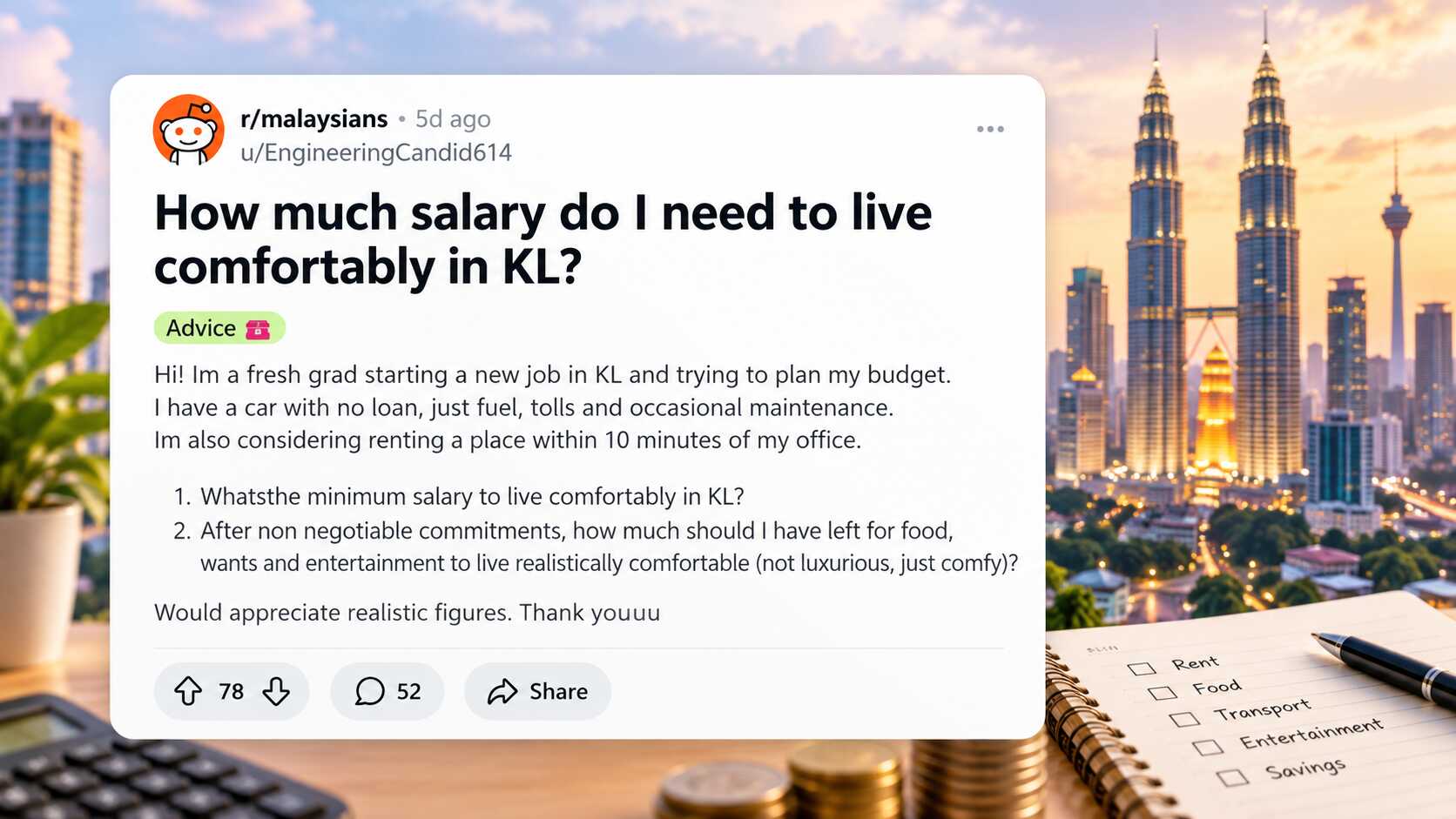
A fresh grad recently asked Reddit a simple question: how much salary do I need to live comfortably in KL? They had a car with no loan. They wanted to rent within 10 minutes of the office. Not luxury, just comfy. Dozens of Malaysians replied. The answers ranged from RM2,500 to RM100,000 a month. Some were jokes. Most were painfully honest. We went through every comment, checked them against expert benchmarks, and worked out the real salary to live comfortably in KL, with budgets you can actually use. TL;DR Baseline: economists treat around RM3,100 a month as the minimum reference point for basic needs in cities like KL. It works, but it is tight. Decent (single): RM3,500 to RM5,000 gross was the most common answer for a fresh grad. Comfortable (single): RM6,000 to RM8,000, with room to save, invest and enjoy. Family: Malaysians on Reddit put it at around RM7,000 for a couple and RM12,000 with kids. Biggest cost: rent. A room near a KL office starts around RM750 to RM1,000. The gap: many fresh grads earn well below "comfortable". A REN career needs only SPM and a 2-day course, with no salary ceiling. Source: https://www.reddit.com/r/malaysians/comments/1xbluxa/how_much_salary_do_i_need_to_live_comfortably_in/ The question that started it all on r/malaysians. How much salary do you need to live comfortably in KL? There is no single salary to live comfortably in KL, because "comfortable" means different things to different people. But the Reddit replies clustered into four clear levels. LevelMonthly gross salary (single)What life looks likeSurviveRM2,500 to RM3,000Shared room, cooking or cheap meals, savings of RM200 to RM300 if you are strictDecentRM3,500 to RM5,000Own room near work, eating out on workdays, a real emergency fundComfortableRM6,000 to RM8,000Better home, regular savings and investing, fun without guiltTruly comfortableRM10,000 and aboveService apartment in central KL, supporting parents, travel The expert view lines up with the bottom of this table. Economists commenting in August 2026 called RM3,100 a minimum reference point, not a comfortable one. One noted it buys roughly what RM2,500 did in 2020. For context, Malaysia's minimum wage is RM1,700. That is a long way from even the baseline. What eats your salary in KL? One commenter summed it up perfectly. Food, rent and vehicle eat most of your pay. Cut one or two of those, and you suddenly have money left at the end of the month. Rent: the budget killer Almost every reply mentioned rent first. Here is what Malaysians on the thread said it really costs: Room near a KL office: around RM1,000, or about RM750 in an older building Room further out: around RM700 Service apartment within 10km of the city centre: RM2,500 and up, plus around RM200 for parking The smartest advice? If you already have a car, live a little further out. If not, rent near an LRT or MRT station. Either way, you trade a few minutes of commute for hundreds of ringgit a month. Comment by u/EngineeringCandid614 from discussion in malaysians A room near a KL office starts around RM1,000, according to one commenter. Food: RM30 to RM60 a day adds up fast Estimates ranged from RM30 a day for a careful eater to RM35 to RM60 a day if you eat out for every meal. At RM30 a day on workdays only, that is about RM600 a month. Add groceries and household items, and it is closer to RM1,000. Transport: car or no car Petrol, tolls and parking were estimated at around RM300 to RM500 a month for someone who drives to work in KL. One commenter with no car, eating near a university cafe, kept total spending to about RM1,900 to RM2,200. No car and cheap food is the cheat code, but it does not suit everyone. A realistic budget on a RM4,000 salary The most useful reply on the thread did the actual maths on the salary to live comfortably in KL as a fresh grad. Here is a cleaned-up version based on it. On RM4,000 gross, after EPF, SOCSO, EIS and tax, you take home roughly RM3,500. ItemMonthly (RM)Room near the office800Food and groceries900Petrol, tolls and parking350Phone, internet and utilities200Medical card or insurance150Emergency fund and savings700Wants and entertainment400Total3,500 It works, but there is not much slack. One car repair or a family emergency, and the savings line disappears. The commenter's rule was simple and wise. Build six months of emergency funds first, then think about entertainment. Comment by u/EngineeringCandid614 from discussion in malaysians The most practical answer in the thread: a line-by-line budget on RM4,000. Use the 50/30/20 rule as a starting point Another commenter suggested the 50/30/20 split. On RM3,500 take-home, it looks like this: 50% needs: RM1,750 for rent, food, transport and bills 30% wants: RM1,050 for eating out, hobbies and fun 20% savings: RM700 for your emergency fund and investments In KL, needs often spill past 50%. That is normal. Just protect the 20% savings line first. Single, couple or family: how much more do you need? Several replies scaled the salary to live comfortably in KL by household size. The pattern was consistent. HouseholdReddit estimate (monthly gross)SingleRM4,000 to RM7,000CoupleRM7,000 to RM9,000 and aboveFamily with kidsRM12,000 and aboveSupporting parents and renting your own placeAround RM10,000 Your family situation matters more than almost anything else. One commenter said RM4,000 felt like plenty while living with parents rent-free. Remove that safety net, and the number more than doubles. The real problem: the gap between "comfortable" and a fresh grad salary This is where the thread got real. When one person said you need RM10,000 to be comfortable, others pushed back hard. They reminded everyone that the person asking is a fresh grad, and that calling RM5,000 to RM6,000 "the minimum" is unrealistic for most new graduates. Then came the replies. One person in their 40s said they earn RM5,000. Another said they earn RM2,300 at 27. Comment by u/EngineeringCandid614 from discussion in malaysians The gap between what comfort costs and what many people earn, in one reply chain. So how do you reach the salary to live comfortably in KL? What were the solutions offered? Ask for a raise. Or find a remote job paying in US dollars. Even the commenters admitted the second one is rare for most fresh grads. You can budget your way to "survive". You usually cannot budget your way to "comfortable". At some point, the answer is earning more. Wondering what property agents actually earn? See the real commission maths behind a real estate career in Malaysia. Read the earnings guide How can you earn more without a degree? Most high-paying paths in Malaysia ask for years of study, a professional certificate, or years of climbing a pay scale. Real estate is different. To become a Real Estate Negotiator (REN), the minimum education is SPM. No degree. No diploma. What you need to become a REN Age 18 and above SPM or equivalent, with a pass in Bahasa Malaysia A non-bankruptcy certificate A 2-day Negotiator Certification Course (NCC), from about RM600 plus tax Registration with BOVAEP through a registered agency like IQI Most people get their REN tag in about 4 to 8 weeks, for under RM1,000 in total. Compare that to a three or four-year degree. For the full step-by-step process, read our guide on how to be a property agent in Malaysia in 5 steps. How does a REN earn money? Let's be honest about this part. A REN earns commission, not a fixed monthly salary. That means your income depends on the deals you close. Here is how the maths works on a subsale: Malaysian subsale commission is typically 2% to 3% of the sale price A RM500,000 home sold at 2% earns RM10,000 in gross commission Your share depends on your tier and your agency's commission structure Rentals close faster and earn smaller fees, which helps new agents build steady income while they work on bigger sales. The first few months are a ramp-up period while you learn the market and build a client base. Plan for it. But unlike a fixed salary, there is no ceiling on how far your income can grow. Want the details? Read our breakdown of the real estate agent commission structure in Malaysia. Why it fits a KL fresh grad Look back at that Reddit thread. Whatever salary you need to live comfortably in KL, the single biggest cost for every commenter was rent. As a REN, you learn the property market from the inside. You know which areas offer better rents, when to buy, and how to make your own housing costs work for you, not against you. Plenty of IQI agents started with no property background at all. Alvin Chan went from hawker to real estate agent. Natasha switched from journalism to leading her own team. If you want the full career picture, start with our guide to becoming a real estate agent in Malaysia. Why join IQI Global? IQI is one of Malaysia's largest real estate networks, with 30,000+ property professionals across 20+ countries. Fast 5-day commission payout, so you are not waiting months to get paid No-forfeit policy on your commission Full training and mentorship to help you close your first deal In-house tech, including IQI Atlas and IQPilot, to manage leads and listings Local and global listings under a trusted brand Frequently asked questions How much salary do you need to live comfortably in KL as a single person? Most Malaysians on Reddit said RM6,000 to RM8,000 a month for a comfortable single life in KL. RM3,500 to RM5,000 is considered decent, and economists treat around RM3,100 as the minimum reference point for basic needs. Is RM3,000 enough to live in KL? Yes, but it is tight. You would likely need a shared room, careful food spending and little room for wants. One commenter with no car spent about RM1,900 to RM2,200 a month by eating cheaply and using public transport. How much is rent in KL for a room near the office? According to Malaysians on the thread, a room within 10 minutes of a KL office costs around RM1,000, or about RM750 in an older building. A service apartment within 10km of the city centre starts around RM2,500. How much salary do you need in KL with a family? Reddit estimates put it at around RM7,000 to RM9,000 for a couple and RM12,000 or more for a family with children. Supporting parents while renting your own place pushes the number to around RM10,000. Can I become a property agent in Malaysia with only SPM? Yes. To register as a Real Estate Negotiator (REN), you need SPM or equivalent with a pass in Bahasa Malaysia, a 2-day Negotiator Certification Course, and BOVAEP registration through a registered agency. No degree is required. Does a REN get a basic salary? No. A REN earns commission from completed sales and rentals, not a fixed salary. Income depends on the deals you close, and there is no salary ceiling. Expect a ramp-up period in the first few months How long does it take to become a REN? Most people complete the process in about 4 to 8 weeks, including the 2-day NCC and BOVAEP processing, usually for under RM1,000 in total. Figures in this article are based on a public r/malaysians discussion (October 2026) and economist commentary reported in August 2026. They are estimates for guidance only. Your actual costs depend on your area, lifestyle and commitments. You can't budget your way to a comfortable life. But you can earn your way there. All you need is SPM and a 2-day course. IQI agents earn uncapped commission, get paid within 5 days, and receive full training to close their first deal. Fill in your details below to start your journey. [custom_blog_recruit_form] Continue reading Minimum Wage Raised to RM1.7k. But Is It Really Enough to Buy a House in KL? Real Estate Agent Salary in Malaysia: How Much Do They Really Make? 10 Years as a Property Agent: Lessons From MarieJualKondo
Ready to get started?
Get in touch now.
