


Every Johor forecast published in the last two years has leaned on the same two events. Both of them finally land inside the next four months.
The Rapid Transit System Link is scheduled to carry its first passengers on 1 January 2027. The Johor-Singapore Special Economic Zone master plan is due to be launched in December 2026.
So 2027 is the year the promises get tested. That makes it a very different year to plan for than 2025 or 2026 were.
This is our institutional view of what changes, what does not, and where we think the market is mispricing the risk. It is deliberately less enthusiastic than most of what you will read on this topic.
TL;DR
- RTS Link opens 1 January 2027. Bukit Chagar to Woodlands North, roughly 5 minutes, 10,000 passengers per hour each direction, about 40,000 riders a day expected at launch.
- The JS-SEZ master plan launches in December 2026 at the Annual Leaders’ Retreat. It has already slipped three times.
- Johor is a two-speed market. Industrial and landed have the momentum. High-rise carries the supply risk, with 108,863 existing serviced apartment units and another 60,544 in the pipeline through 2030 to 2031.
- Industrial land has roughly doubled, from RM70 to RM80 per sq ft in 2024 to around RM150 per sq ft, driven mainly by data centre demand.
- The binding constraint is power, not demand. Data centres could take 40% of Johor’s electricity by 2035.
- Our base case for 2027 is selective strength, not a broad rally. The real test arrives in 2028.
What this forecast covers
- TL;DR
- What actually happens between now and the end of 2027?
- Why is Johor really a two-speed market?
- Is Johor Bahru high-rise in a bubble?
- What incentives apply under the JS-SEZ, and who qualifies?
- What is the real constraint on Johor’s industrial story?
- Does the RTS Link change the cross-border maths?
- Our assumptions
- Base, bull and bear: three scenarios for 2027
- What does this mean for you?
- Frequently asked questions
What actually happens between now and the end of 2027?
Start with the calendar, because almost every argument about Johor rests on these four dates.
| Event | Date | Why it matters |
|---|---|---|
| Belanjawan 2027 tabled | 9 October 2026 | Sets federal allocations, and any change to stamp duty or RPGT lands here |
| Johor-Singapore Cooperation Ministerial Committee | November 2026 | Ministerial groundwork ahead of the master plan launch |
| JS-SEZ Master Plan launch | December 2026 | Investor clarity on zones, sectors, incentives and agency coordination |
| RTS Link passenger service | 1 January 2027 | The single biggest change to cross-border commuting in decades |
| Singapore VEP increase | 1 January 2027 | Cars rise from S$35 to S$50, motorcycles from S$4 to S$7 |
How firm are these dates?
The RTS looks solid. As of August 2026 the Bukit Chagar station and the Malaysian CIQ complex were structurally complete and the project had moved into testing and commissioning.
The master plan is a different story, and you should price that in. It was first expected by the end of 2025, then moved to 30 March 2026, then to the second quarter, then to the fourth, and it now sits in December.
A plan that has moved three times can move a fourth. Any 2027 model that assumes a December launch should carry a scenario where clarity does not arrive until the first half of 2027.
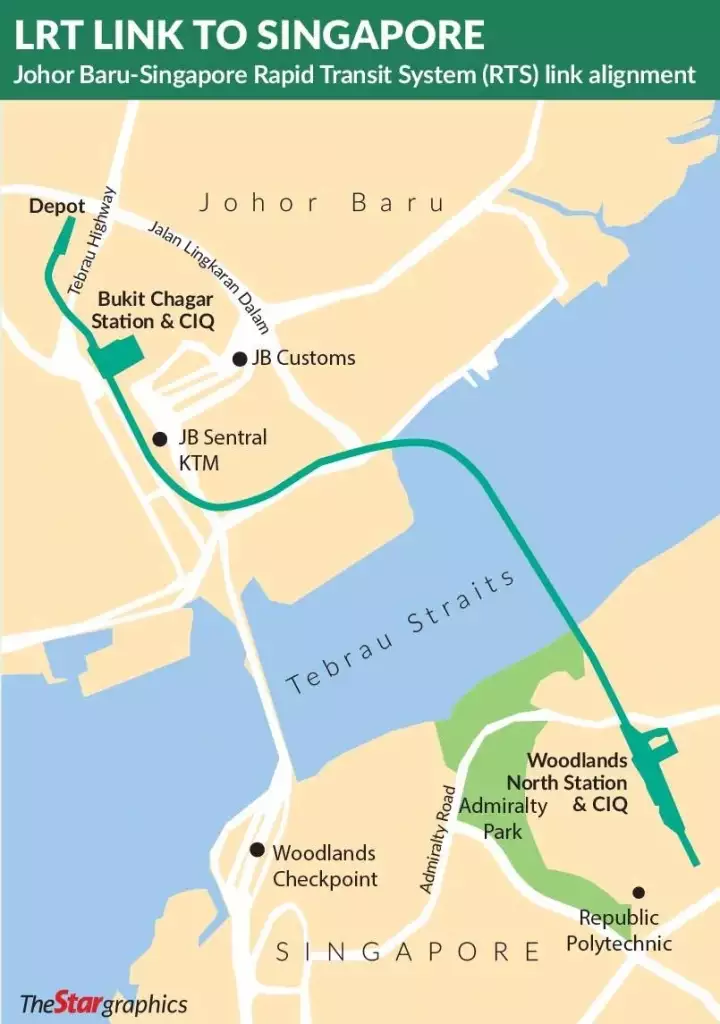
Image source: LandTransport Guru
Why is Johor really a two-speed market?
This is the most useful frame we can give you, and it explains why intelligent people look at the same market and reach opposite conclusions.
They are not disagreeing. They are describing different segments.
Speed one: industrial and landed
Prime industrial land in Johor has climbed from RM70 to RM80 per sq ft in 2024 to roughly RM150 per sq ft, driven largely by data centre operators.
The transaction data tells the same story. In the first nine months of 2025, commercial transaction values rose 29.5% year on year and industrial rose 30.5%. Residential managed 3.4%.
Johor also pulled RM91.1 billion in approved investment over that period, the highest of any state, with the JS-SEZ accounting for RM68 billion of it. Singapore was the largest single source at RM28.5 billion.
That is not a housing story. It is an industrial story with housing attached.
Speed two: high-rise residential
Here the picture inverts. Johor Bahru had 108,863 existing serviced apartment units as at the first quarter of 2026, with a further 60,544 units under construction or planned through 2030 to 2031.
That is a pipeline worth more than half the standing stock, arriving into a market where the demand case is largely forward-looking.
CIMB Securities has kept a neutral rating on the property sector specifically on this basis, favouring industrial and landed exposure while flagging oversupply risk in JB high-rise.
If you are looking at specific projects rather than the market as a whole, our guide to developments near the RTS Link breaks down the individual addresses.
Is Johor Bahru high-rise in a bubble?

You will hear this argued both ways with equal confidence. Here is the honest version.
The bear case
New launches near the RTS have been marketed at around RM1,500 per sq ft. The median transacted price for subsale property in the same area sits just below RM900 per sq ft.
More pointedly, transactions above RM1,000 per sq ft made up less than 0.1% of Johor Bahru high-rise deals across 2024 and 2025.
The bear reading is straightforward. When launch pricing detaches this far from the secondary market, and supply is set to expand sharply at the same time, you have the conditions that produced the Iskandar Puteri correction between 2013 and 2023.
The bull case
The price gap with Singapore is not a marketing line, it is arithmetic. The average residential price in Johor was RM487,128 in the first quarter of 2026. The average resale HDB flat in Singapore was around RM2.1 million.
Even after Malaysia doubled foreign-buyer stamp duty in January 2026, the saving is large enough to absorb the additional tax comfortably.
Our reading
The Socio-Economic Research Centre found no apparent sign of an overheating bubble despite some speculative buying, while noting the need for supply and demand alignment and better price transparency.
Ground-level data supports the calmer view. Olive Tree Property Consultants found Johor Bahru prices broadly stable through the first quarter of 2026, with selective rather than broad-based increases. Landed schemes moved modestly, with a double-storey terrace in Taman Molek rising to RM1.1 million from RM980,000 and Horizon Hills moving from RM800,000 to RM820,000.
Both camps are right about different things. Landed and mass-market Johor is stable and fundamentally supported. A specific slice of RTS-adjacent new-launch high-rise is priced for an outcome that has not happened yet.
Treat those as two markets, and most of the confusion disappears.
The mistake is treating Johor as one market. Landed housing and industrial land are being driven by real occupiers and real investment approvals. A narrow band of high-rise product near the RTS is being priced on expectation. Investors who separate the two will do well. Investors who do not are taking industrial-grade risk for residential-grade returns.
Kashif Ansari, Co-Founder and Group CEO, Juwai IQI
What incentives apply under the JS-SEZ, and who qualifies?
If you are assessing an entry rather than reading for interest, this is the section that matters.
| Incentive | What it offers | Applies to |
|---|---|---|
| Special corporate tax rate | 5% for up to 15 years | New investments in qualifying high-value activities |
| Investment tax allowance | 100% on qualifying capital expenditure | Qualifying capital investment |
| Stamp duty exemption | Full exemption | Commercial property transactions |
| Accelerated capital allowance | Faster write-down | Renovation expenditure |
| Flat personal income tax | 15% for 10 years | Eligible knowledge workers |
| Fast-track approvals | Manufacturing licences within seven days | Applications through IMFC-J |
The talent layer matters too, and it is often overlooked in property analysis. The zone targets 20,000 high-skilled jobs over five years, and the Johor Talent Development Council has set premium minimum salaries of RM4,000 for diploma holders and RM5,000 for Malaysian Skills Certificate holders at degree equivalent.
Those wage floors are the mechanism that turns investment approvals into housing demand. Approvals alone do not fill units. Salaries do.
For the wider zone background, see our overview of JS-SEZ investment opportunities.
What is the real constraint on Johor’s industrial story?
Not demand. Power.
Johor approved 51 data centre projects worth RM182.96 billion as at November 2025, of which 17 were operational, 11 under construction and 23 approved but not yet started.
Wood Mackenzie’s assessment is that Johor’s data centres could consume 40% of the state’s electricity demand by 2035, an increase of roughly 24 percentage points. Their framing is the one to hold onto: the question is increasingly about where power is available rather than whether it is available.
The arithmetic is tight. Johor has around 6.8 GW of installed generation capacity, mostly gas and coal, with 2.1 GW of coal-fired plant due to retire in the 2030s.
Fitch Ratings reaches the same conclusion from the credit side, noting that growth in both Singapore and Johor will be shaped more by infrastructure readiness than by demand, and that new projects face greater delay risk from power availability, grid upgrades and equipment lead times.
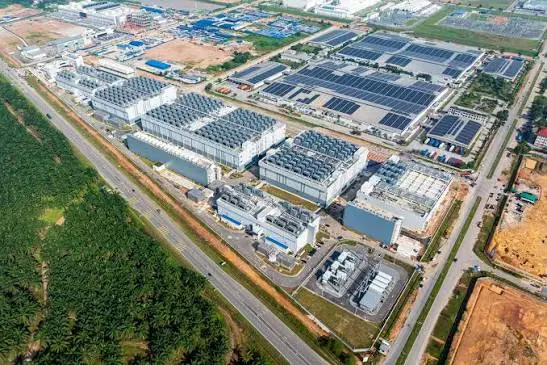
Image source: StarProperty
Why this matters for property specifically
The RM150 per sq ft industrial land figure rests on data centre bidding. If grid readiness caps new approvals, and Johor’s existing freeze on water-intensive Tier 1 and Tier 2 facilities stays in place, the marginal buyer for industrial land thins out.
There is a second-order effect worth planning for. The construction cycle peaks before occupancy does.
Major Johor data centre contracts currently run to completion dates of mid-2027, the fourth quarter of 2027 and the second quarter of 2028. Building these facilities employs many times more people than running them.
If your rental thesis depends on data centre workers, know which phase you are underwriting. The handover from construction workforce to operational workforce happens inside your holding period.
We looked at this in more depth in Malaysia’s data centre boom and its impact on housing supply.
Does the RTS Link change the cross-border maths?
Yes, and the VEP increase is the underrated half of it.
From 1 January 2027, foreign-registered cars entering Singapore pay S$50 a day instead of S$35, and motorcycles pay S$7 instead of S$4. That is a 43% increase for cars and 75% for motorcycles, landing in the same month the train opens.
Samuel Tan, chief executive of Olive Tree Property Consultants, has argued that this looks like a deliberate push to move daily commuters onto the RTS rather than driving across the Causeway, and that it should support demand for homes near RTS stations as commuters start prioritising accessibility.
He has also made the structural argument we find most persuasive, comparing the JS-SEZ to the Hong Kong and Shenzhen model, with Singapore providing financial and headquarters functions while Johor provides land and labour at lower cost. On his reading, the transit network is what makes that twinning model workable.
What a cross-border buyer is really comparing
Run your own numbers rather than trusting a brochure. The calculator below handles the repayment side.
Estimates for guidance only. Actual figures depend on the bank’s assessment, current rates, and your full financial profile.
The difference between the right Johor asset and the wrong one is about two kilometres.
Catchment, tenure, completion year and competing supply decide the outcome long before the market does. An IQI adviser will walk you through the specific asset you are considering, with the transaction data behind it.
Or review the pipeline directly: new launches and land.
Our assumptions
Every forecast rests on things that may not happen. Here are ours, stated plainly so you can stress-test them against your own view.
- The RTS Link opens on or close to 1 January 2027 and reaches meaningful daily ridership within the first two quarters.
- The JS-SEZ master plan is launched in December 2026 and published in enough detail to guide capital allocation.
- No further change to foreign-buyer stamp duty or RPGT in Belanjawan 2027.
- The overnight policy rate stays broadly where it is through 2027.
- Johor’s freeze on water-intensive data centre categories remains, but AI-related approvals continue.
- Feeder transit, whether ART or APM, is still not operational during 2027.
If two or more of these break, the base case below no longer holds.
Base, bull and bear: three scenarios for 2027
| Bear | Base | Bull | |
|---|---|---|---|
| Trigger | Master plan slips again, RTS ridership undershoots, grid constraints stall industrial approvals | RTS opens on time, master plan lands in December, feeder transit still absent | Master plan lands with detailed zoning, RTS ridership beats projections, feeder transit funded |
| Landed residential | Flat | Modest, selective growth | Broad-based growth in RTS and ART catchments |
| High-rise, RTS catchment | New-launch pricing corrects toward subsale levels | Sharp split between walkable and non-walkable addresses | Rental absorption validates current launch pricing |
| High-rise, wider JB | Rising overhang, rental compression | Soft, competing with the completion pipeline | Spillover demand lifts the second ring |
| Industrial land | Plateau as data centre bidding slows | Holds near current levels | Continues climbing on fresh AI-linked approvals |
We hold the base case. Our reading is that 2027 delivers selective strength rather than a broad rally, and that the genuine test arrives in 2028, when the construction cycle rolls off and the high-rise completion wave meets the market at the same time.
What does this mean for you?
If you are an institutional or industrial investor
Power availability is your diligence priority, not land price. Confirm the substation position, the grid connection timeline and the energy supply agreement status before you underwrite the land. Wood Mackenzie’s point about location-specific grid pressure is the operative risk.
If you are a developer holding Johor landbank
The landed and industrial-adjacent portions of your bank are working. The high-rise portion faces a 2028 to 2031 competition problem that is already visible in the pipeline data. Phasing decisions made in 2027 will matter more than pricing decisions.
If you are a cross-border individual investor
Walkability to Bukit Chagar is doing more work in the price than most buyers realise, and the feeder transit that would extend that catchment is not built yet. The second ring is cheaper for a reason that is real today and may not be real in 2029. That is a timing bet, so size it like one.
Johor’s fundamentals are the strongest they have been in a decade. That is exactly why discipline matters now. Infrastructure creates value over years, not over launch weekends, and the assets that reward patience are rarely the ones with the loudest marketing.
Kashif Ansari, Co-Founder and Group CEO, Juwai IQI
About this forecast. Prepared by Juwai IQI using research from CIMB Securities, Wood Mackenzie, Moody’s Ratings, Fitch Ratings, the Socio-Economic Research Centre and Olive Tree Property Consultants. Figures as at 7 September 2026. Next scheduled review: after the JS-SEZ master plan launch in December 2026. This is general market commentary and not investment advice.
Frequently asked questions
Passenger service is scheduled to begin on 1 January 2027, connecting Bukit Chagar in Johor Bahru with Woodlands North in Singapore. The journey takes about five minutes and the system is designed for 10,000 passengers per hour in each direction, with roughly 40,000 riders a day expected at launch.
It is expected to be launched in December 2026 at the Annual Leaders’ Retreat, jointly by the Malaysian and Singaporean prime ministers. The launch has been postponed several times, having originally been expected by the end of 2025.
It depends entirely on the segment. Landed and mass-market housing has been stable, with selective rather than broad price increases. A narrow band of new-launch high-rise near the RTS has been marketed at levels well above the subsale median in the same area, and that specific slice carries genuine correction risk.
Qualifying high-value activities can access a special corporate tax rate of 5% for up to 15 years, a 100% investment tax allowance on qualifying capital expenditure, stamp duty exemption on commercial property transactions, accelerated capital allowance on renovation, and a flat 15% personal income tax rate for eligible knowledge workers over 10 years.
Johor Bahru had 108,863 existing serviced apartment units as at the first quarter of 2026, with a further 60,544 units under construction or planned through 2030 to 2031.
Demand remains strong, but power is the constraint. Johor’s data centres could consume 40% of state electricity demand by 2035, and grid readiness rather than investor appetite is likely to determine how many further projects proceed.
Forecasts are useful. Transaction data is decisive.
IQI tracks Johor transactions, completions and rental movement through Realtycheck, our own property data platform. Fill in your details below and one of our Johor agents will connect with you to discuss what the numbers actually say about the catchment you are looking at.
Fill in your details below and our agent will be in touch.
Continue reading:
References and sources:
- JS-SEZ – Steady as it goes, Lee Heng Guie, 7 January 2026 (https://www.thestar.com.my/business/insight/2026/01/07/js-sez—steady-as-it-goes) | The Star
- Johor govt urges immediate release of JS-SEZ master plan, edited by Presenna Nambiar, 2 July 2026 (https://theedgemalaysia.com/node/809167) | The Edge Malaysia
- JS-SEZ ready for next step, 1 August 2026 (https://www.thestar.com.my/news/nation/2026/08/01/js-sez-ready-for-next-step) | The Star
- Malaysia, Singapore to jointly launch JS-SEZ master plan in December, says Akmal Nasrullah, 31 July 2026 (https://www.malaymail.com/news/malaysia/2026/07/31/malaysia-singapore-to-jointly-launch-jssez-master-plan-in-december-says-akmal-nasrullah/229782) | Malay Mail
- Single permits key to unlocking JS-SEZ potential, September 2026 (https://www.nst.com.my/business/economy/2026/09/1525649/single-permits-key-unlocking-js-sez-potential) | New Straits Times
- CIMB Securities flags diverging outlook between asset classes in Johor, edited by Isabelle Francis, 16 July 2026 (https://theedgemalaysia.com/node/810909) | The Edge Malaysia
- The Edge Malaysia | Olive Tree Property Consultants Johor Bahru Housing Property Monitor 1Q2026: Remaining resilient amid geopolitical uncertainty, 5 June 2026 (https://theedgemalaysia.com/node/804728) | The Edge Malaysia
- Johor election won’t hurt property market, 5 July 2026 (https://www.thestar.com.my/business/business-news/2026/07/05/johor-election-wont-hurt-property-market) | The Star
- State election unlikely to derail Johor home sales, June 2026 (https://www.nst.com.my/property/2026/06/1475943/state-election-unlikely-derail-johor-home-sales) | New Straits Times
- Equity market resilient despite Johor volatility, 14 July 2026 (https://www.thestar.com.my/business/business-news/2026/07/14/equity-market-resilient-despite-johor-volatility) | The Star
- ohor’s data centres could consume 40% electricity demand by 2035, says WoodMac, edited by S Kanagaraju, 18 June 2026 (https://theedgemalaysia.com/node/807442) | The Edge Malaysia
- Powering Johor’s Data Centre Boom: Supply, Demand, and Grid Constraints, Alvin Tan, June 2026 | Wood Mackenzie
- Singapore’s low data centre rate to propel demand in Johor, 1 September 2026 (https://www.thestar.com.my/business/business-news/2026/09/01/singapores-low-data-centre-rate-to-propel-demand-in-johor) | The Star
- Kerjaya Prospek bags first data centre contract worth RM858 mil, edited by Jason Ng, 3 September 2026 (https://theedgemalaysia.com/node/816701) | The Edge Malaysia
- Sunway Construction bags RM664 mil variation orders, lifts Johor data centre contracts to RM865 mil, edited by Isabelle Francis, 18 June 2026 (https://theedgemalaysia.com/node/807321) | The Edge Malaysia
- IJM Corp unit secures RM1.4 bil data centre project in Johor, its biggest yet, edited by Presenna Nambiar, 15 August 2025 (https://theedgemalaysia.com/node/766764) | The Edge Malaysia
- Belanjawan 2027 perlu penuhi harapan rakyat, rancakkan pembangunan negara – PM Anwar (https://mof.gov.my/portal/ms/berita/akhbar/belanjawan-2027-perlu-penuhi-harapan-rakyat-rancakkan-pembangunan-negara-pm-anwar) | Kementerian Kewangan Malaysia
- Belanjawan Johor 2026: Kerajaan negeri peruntuk RM2.546 bilion (https://berita.rtm.gov.my/nasional/senarai-berita-nasional/senarai-artikel/belanjawan-johor-2026-kerajaan-negeri-peruntuk-rm2-546-bilion/) | RTM Berita
- Johor’s economic boost to reach all districts, says MB, March 2026 (https://www.nst.com.my/business/economy/2026/03/1395266/johors-economic-boost-reach-all-districts-says-mb) | New Straits Times
