


Malaysia’s commercial property market closed RM24.13 billion in deals in the first half of 2026.
The headline looks calm, but underneath it a sharp split is forming: some buildings are almost full, while others sit half empty.
With Johor’s data centres booming and the RTS Link and JS-SEZ around the corner, where is the money going, and what does it mean for you?
Key Takeaways
- Commercial deals held steady in 1H2026: 21,454 transactions worth RM24.13 billion, almost unchanged from a year earlier.
- Offices are splitting in two. KL Fringe buildings are 88.6% occupied, while KL’s old CBD is only 54.1% full.
- Industrial property and data centres lead demand, with Johor’s data centre vacancy at just 0.7%.
- The JS-SEZ, the RTS Link (targeted for February 2027) and a stable 2.75% OPR are the main growth drivers.
- The biggest risks are a serviced apartment overhang, new supply and construction costs up about 13%.
What You’ll Discover in This Guide
1. Market performance: flat volume, softer value
Commercial property held its ground in 1H2026, even as the wider market slipped. The National Property Information Centre (NAPIC) recorded 21,454 commercial transactions worth RM24.13 billion, almost unchanged from a year earlier.
| Segment | Transactions 1H2025 | Transactions 1H2026 | Change | Value 1H2025 (RM) | Value 1H2026 (RM) | Change |
|---|---|---|---|---|---|---|
| Commercial | 21,260 | 21,454 | +0.9% | 24.45 | 24.13 | -1.3% |
| Industrial | 4,148 | 3,932 | -5.2% | 14.25 | 14.78 | +3.7% |
| All property | 196,232 | 187,320 | -4.5% | 107.68 | 105.12 | -2.4% |
Sources: NAPIC via The Edge Malaysia, 1H2026 and 1H2025.
Commercial deals made up about 11.5% of all transactions but 23% of total value. That gap is the nature of the asset class: fewer deals, bigger tickets.
| One condition: NAPIC counts serviced apartments and SoHo units as commercial because they sit on commercial-titled land. For more on how the year started, read our NAPIC Q1 2026 breakdown. |
2. Office: a tale of two markets
Office demand is improving, but almost all of it is going to new, green, well-located buildings. Nationwide purpose-built office occupancy rose to 78.5% in 1H2026 from 77.8%, the Finance Ministry reported.
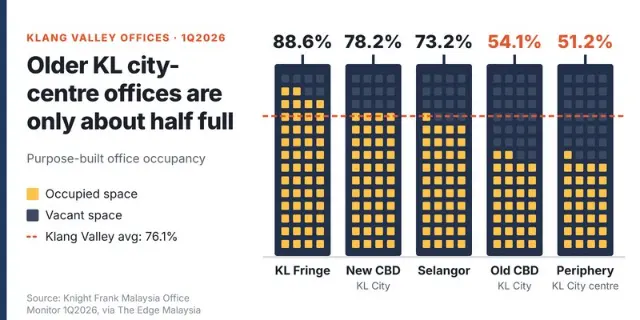
Rents follow the same split. Offices in KL’s new CBD averaged RM7.45 psf a month in 1Q2026, against RM4.47 psf in the old CBD, according to Knight Frank.
Supply is the swing factor. About 4.61 million sq ft of new office space is due in the Klang Valley in 2026 and 2027, mostly in the KL Fringe, while KL’s overall vacancy sits near 30% (Cushman & Wakefield).
For older towers, the answer is refurbishment or conversion into hotels and homes, helped by Budget 2026 tax incentives for repurposing commercial buildings.
3. Retail: prime malls thrive, the rest compete
Retail property is holding up, but shoppers and tenants are getting choosier. Nationwide shopping complex occupancy slipped to 77.9% in 1H2026 from 78.7% a year earlier, according to the Finance Ministry.
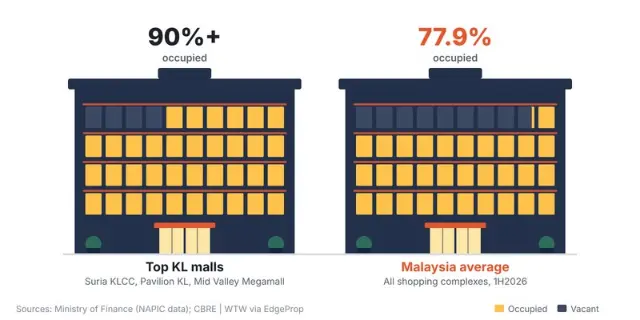
Top malls such as Suria KLCC, Pavilion Kuala Lumpur and Mid Valley Megamall stay above 90% occupied, while older and smaller malls struggle to fill space.
Spending is growing, but slowly. Retail sales rose just 2.5% in 2Q2026, below the 4.8% retailers expected, as shoppers chased vouchers and cheaper brands.
New supply adds pressure. About 2.0 million sq ft of retail space is due in the Klang Valley by end-2026, including 118 Mall at Merdeka 118, which opens in November with more than 300 outlets.
Shop lots face their own supply wave, with completed shop units more than doubling year on year in 1Q2026. Well-located shophouses in busy townships still rent well, but check local vacancy before paying new-launch prices.
Thinking of buying a shoplot or office unit?
Work out your monthly repayments with our mortgage calculator before you start viewing.
4. Industrial, logistics and data centres: the standout
Industrial property is where the strongest demand sits. NAPIC recorded 3,932 industrial deals worth RM14.78 billion in 1H2026, with value up about 3.7% even as the number of deals fell.
Klang Valley warehouses were 96.1% occupied in 1Q2026, even after 2.8 million sq ft of new space was completed (CBRE | WTW). Another 7.2 million sq ft is due by end-2026, which could cool rental growth.
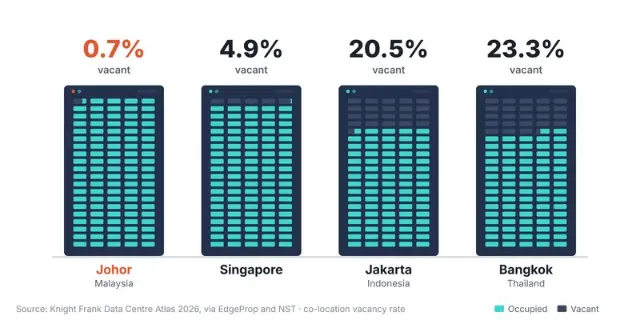
Data centres are the headline act, and Johor leads. It has 1,110 MW of live IT capacity, third in Asia Pacific, and the region’s biggest pipeline at 8,542 MW. Co-location vacancy is just 0.7%, against 4.9% in Singapore.
Land deals follow the servers. Disclosed data centre land and property deals reached about RM1.02 billion in Johor and RM1.4 billion in Selangor and KL in 1H2026.
The catch is utilities. Rising power and water tariffs are narrowing Johor’s cost edge over Singapore, and the state now vets new data centre projects through a special technical committee.
5. What is driving demand
Six forces are shaping commercial property demand in 2026, and most of them favour industrial land, prime offices and well-run malls.
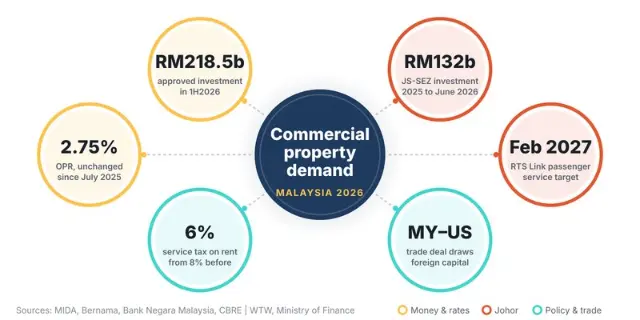
- Strong investment inflows. Malaysia approved RM218.5 billion of investments in 1H2026, up 11.7%, with Selangor and Johor taking about 59%. New factories, offices and data centres all need space.
- The RTS Link. Passenger service is targeted for February 2027, and at least 20 projects have launched within 5 km of the Johor Bahru terminal.
- The JS-SEZ. The Johor-Singapore Special Economic Zone drew RM132 billion of investments from 2025 to June 2026, and qualifying firms pay a 5% corporate tax rate.
- Stable borrowing costs. Bank Negara has held the OPR at 2.75% since July 2025, most recently on 3 September 2026.
- Trade and tech flows. CBRE | WTW expects the Malaysia-US trade agreement to draw more foreign money into industrial parks, mixed-use projects and offices.
- Lower tax on rent. Service tax on rental and leasing fell to 6% from 8% on 1 January 2026, easing costs for business tenants.
6. The risks to watch
The biggest risks are too much new space in the wrong places, rising building costs and a careful consumer.
- Office oversupply. KL’s office vacancy is near 30%, and more towers complete in 2H2026. Older, non-prime buildings will feel it first.
- Rising construction costs. Developers reported costs up about 13% on average in 1H2026 as diesel and bitumen prices climbed.
- Warehouse supply. About 7.2 million sq ft of new Klang Valley industrial space by end-2026 could slow rental growth.
- Careful shoppers. With retail sales up only 2.5% in 2Q2026, malls without a clear draw will struggle to raise rents.
- Rates and geopolitics. Some economists see an OPR hike risk in 2027, and energy prices remain tied to tensions in West Asia.
- Serviced apartment overhang. 23,375 completed serviced apartments worth RM19.33 billion were unsold in 1H2026, over half priced between RM500,001 and RM1 million. See our housing overhang analysis.
7. Outlook for 2027
Expect the two-speed market to carry into 2027. Industrial, logistics, data centres and Johor should lead, while older buildings will need to upgrade, convert or cut rents.
Budget 2027 offers little direct help. Savills’ Paul Khong called it “not a property-led budget”, but still expects industrial, logistics and data centre assets and Johor’s growth corridors to do well.
The gains come indirectly: a RM15 billion TNB grid upgrade that could open data centre sites beyond the Klang Valley, plus enhanced Global Services Hub incentives from January 2027 and a planned elevated ART line in Johor Bahru.
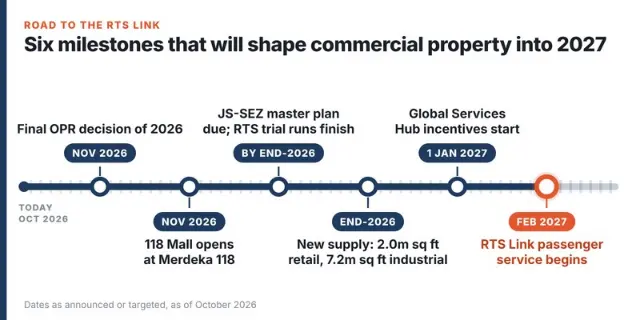
The RTS Link start is the clearest signal of whether cross-border demand turns into higher commercial rents in Johor Bahru.
Conclusion
Malaysia’s commercial property story is no longer about recovery.
It is about relevance: buildings that match how companies now work, shop and store data are pulling ahead, and the rest are being left to reinvent themselves.
For buyers and investors, that rewards homework over headlines.
Look at how full nearby buildings are, what supply is coming within a few kilometres, and whether the asset can keep up with tenants’ rising standards.
Frequently Asked Questions
Steady. NAPIC recorded 21,454 deals worth RM24.13 billion in 1H2026, nearly flat year on year. However, demand is shifting to newer, well-located buildings.
Industrial, logistics and data centres. Klang Valley warehouses are 96.1% occupied, while Johor’s data centre vacancy is just 0.7%.
Yes, in NAPIC’s data, because they sit on commercial-titled land. So check the land title, utility tariffs and maintenance fees before you buy.
It depends on who sells and when. Citizens and PRs pay 30% within three years, falling to 0% from year six. In contrast, companies and foreigners still pay 10% from year six (PwC).
Yes, at 6% since 1 January 2026, down from 8%. However, small businesses with annual sales below RM1.5 million are exempt.
Looking to Invest in Commercial Property?
Whether you are eyeing a shoplot, an office unit or industrial land, our property consultants can help you compare locations, prices and rental potential. Leave your details below and we will get in touch.
Continue Reading:
- Malaysia Housing Overhang 2026: Why RM300K Homes Stay Unsold
- NAPIC Q1 2026: What Malaysia’s Property Data Means for Buyers
- Guide to the Johor Real Estate Market Outlook (2025-2026)
References
- Bank Negara Malaysia. (n.d.). OPR decisions. bnm.gov.my. Retrieved from https://www.bnm.gov.my/monetary-stability/opr-decisions
- CBRE | WTW. (2026). CBRE | WTW. (2026). Klang Valley property market, 1Q 2026 [MarketView snapshot]. cbre-wtw.com.my. Retrieved from https://cbre-wtw.com.my/wp-content/uploads/2026/05/Klang-Valley-Snapshot-1Q-2026.pdf
- EdgeProp.my. (2026, July 31). EdgeProp.my. (2026, July 31). Johor leads Asia-Pacific data centre pipeline as Klang Valley sees 1H2026 investment rebound, says Knight Frank. edgeprop.my. Retrieved from https://www.edgeprop.my/content/1916967/johor-leads-asia-pacific-data-centre-pipeline-klang-valley-sees-1h2026-investment-rebound-says-knight-frank
- Malaysian Investment Development Authority. (2026, August 28). Malaysia secures RM218.5 billion in approved investments in 1H 2026, with domestic investment in manufacturing up 23%. mida.gov.my. Retrieved from https://www.mida.gov.my/media-release/malaysia-secures-rm218-5-billion-in-approved-investments-in-1h-2026-with-domestic-investment-in-manufacturing-up-23/
- Ministry of Finance Malaysia. (2026, September 10). Majlis Pelancaran Laporan Pasaran Harta Separuh Pertama Tahun 2026 [Speech by the Minister of Finance II]. mof.gov.my. Retrieved from https://mof.gov.my/portal/images/2026/09/12/20260910-Teks-Ucapan-MK-II-Pelancaran-LPH-2026.pdf
- National Property Information Centre. (n.d.). NAPIC official portal. napic.jpph.gov.my. Retrieved from https://napic.jpph.gov.my/
- PwC Malaysia. (n.d.). Real property gains tax. In 2025/2026 Malaysian tax booklet. pwc.com. Retrieved from https://www.pwc.com/my/en/publications/mtb/real-property-gains-tax.html
- The Edge Malaysia. (2025, September 4). Malaysia’s property market softens as deal volume dips, developers slow launches, first-half data shows. theedgemalaysia.com. Retrieved from https://theedgemalaysia.com/node/769317
- The Edge Malaysia. (2026, June 18). Klang Valley office market showed modest improvement in 1Q2026. theedgemalaysia.com. Retrieved from https://theedgemalaysia.com/node/806058
- The Edge Malaysia. (2026, September 10). Malaysia flags growing property overhang amid slowing transactions in 1H2026. theedgemalaysia.com. Retrieved from https://theedgemalaysia.com/node/817533
